Learn what every symbol on the card means.Full credits and sources at beakbrain.com/symbols
 ForestCavity nestSmall · 59 g
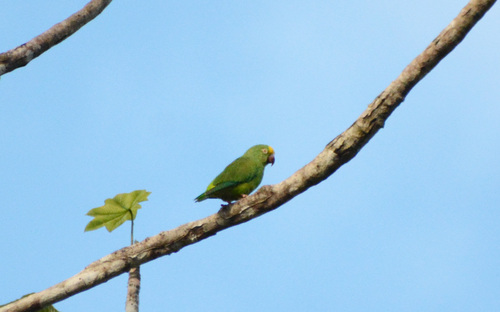
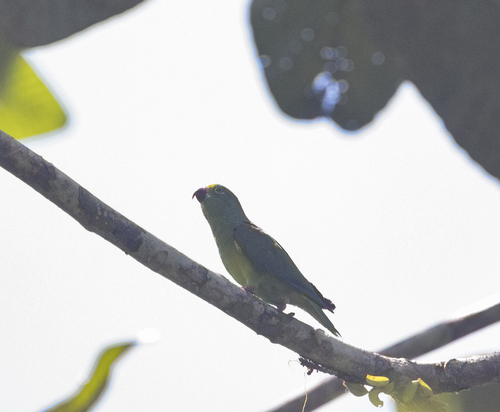
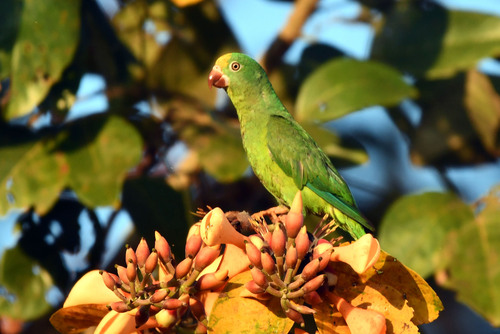
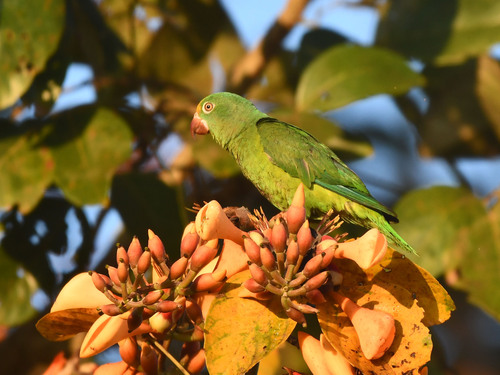
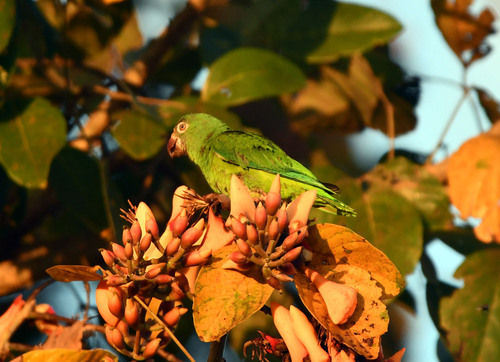
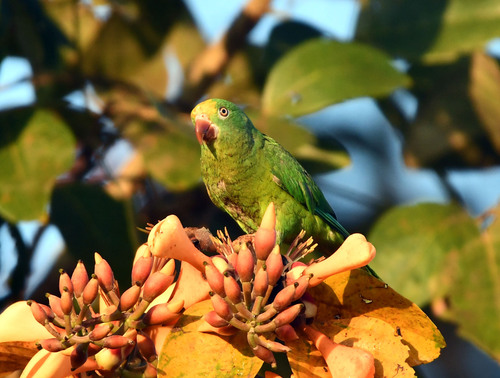
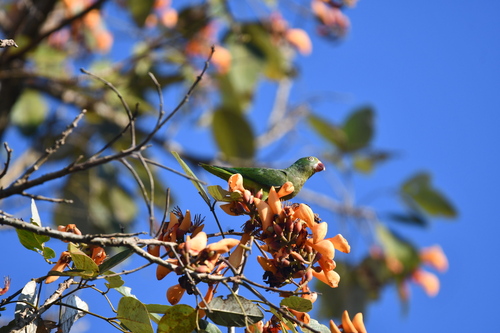
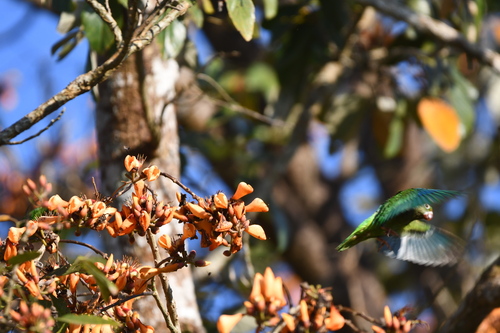
ID tip
The tui parakeet is 17 to 19 cm (6.7 to 7.5 in) long and weighs an average of 59 g (2.1 oz). Adults are mostly green that is yellower on the rump and underparts. They have yellow lores and forehead and a bluish tinge on the face. Their primaries are a darker green than the body and bluish on their underside. Their bill is brown. Subspecies B. s. takatsukasae differs from the nominate only by adding a yellow streak behind the eye. Immature birds are essentially the same as adults. Voice: The tui parakeet's calls include "a high-pitched "klee", shrill "chree" or bisyllabic "chree-chree" fast chattering series "cra-cra-cra-cra-cra"." Members of a flock often call simultaneously.
Text from Wikipedia, licensed CC BY-SA 4.0.
When to see the Tui Parakeet
One bar for each month. Filled bars are the 9 months with records; pale bars are months with none. The wide bar is July, the month with the most records.
Where to see the Tui Parakeet
The map shades 4 countries with regular records. Everything unshaded has no records. Countries are listed below the map.
About the Tui Parakeet
The tui parakeet is a species of bird in subfamily Arinae of the family Psittacidae, the African and New World parrots. It is found in Bolivia, Brazil, Colombia, Peru, and possibly Ecuador.
Text adapted from Wikipedia, licensed CC BY-SA 4.0.
Easily confused with
 Golden-winged ParakeetBrotogeris chrysopteraThe golden-winged parakeet is about 16 cm (6.3 in) long and weighs 47 to 80 g (1.7 to 2.8 oz).
 Grey-cheeked ParakeetBrotogeris pyrrhopteraThe grey-cheeked parakeet is 19 to 20.5 cm (7.5 to 8.1 in) long and weighs between 60 and 68 g (2.1 and 2.4 oz).
 White-winged ParakeetBrotogeris versicolurusThe white-winged parakeet typically is 22 cm in length, and is mostly green in color.
Side by side: Cobalt-winged Parakeet vs Tui Parakeet · Tui Parakeet vs White-winged Parakeet · Golden-winged Parakeet vs Tui Parakeet · Grey-cheeked Parakeet vs Tui Parakeet
Learn the Tui Parakeet in the BeakBrain App
Photo and call practice. Coming soon to iPhone and Android.
Play today's Daily BirdEvery photo and recording on this page is credited to its author under the licence shown. Spotted a problem with this page, or have a better photo? Contribute.