Learn what every symbol on the card means.Full credits and sources at beakbrain.com/symbols
 ForestDomed nestTiny · 14 g

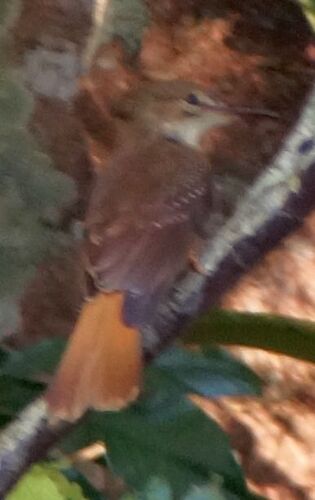
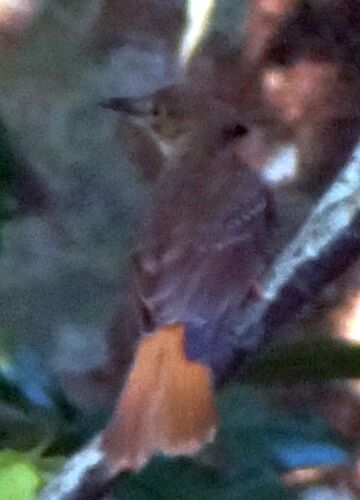


ID tip
The tropical royal flycatcher is approximately 12.5 to 18 cm (4.9 to 7.1 in) long and weighs 9.7 to 21 g (0.34 to 0.74 oz). It has an erectile fan-shaped crest. In the nominate subspecies O. c. coronatus it is red with blue tips in the male and yellow or orange in the female. The sexes' plumages are otherwise alike. Adults have a broken buffy eye ring and a faint buffy streak on the cheek. Their upperparts are dark brown with narrow black and buffy bars on the lower back. Their rump and tail are cinnamon-rufous that is browner towards the end of the tail. Voice: The tropical royal flycatcher is usually inconspicuous and quiet. Its songs differ among the subspecies. That of O. c. coronatus and O. c. castelnaui is "a series of long melodious whistles, starting with a loud flat-pitched introductory note and followed by a series of lower-pitched disyllabic mellow whistles wheeee-pihuuw-pihuuuw-pihuuw". That of O. c.
Text from Wikipedia, licensed CC BY-SA 4.0.
When to see the Tropical Royal Flycatcher
One bar for each month, and every month is filled: this bird is recorded here in all twelve. The wide bar is March, the month with the most records.
Where to see the Tropical Royal Flycatcher
The map shades 17 countries with regular records. Everything unshaded has no records. Countries are listed below the map.
About the Tropical Royal Flycatcher
The tropical royal flycatcher is a passerine bird that most taxonomic systems place in family Onychorhynchidae. It is found in Mexico, south through most of Central America, and in every mainland South American country except Argentina, Chile, Paraguay, and Uruguay.
Text adapted from Wikipedia, licensed CC BY-SA 4.0.
Easily confused with
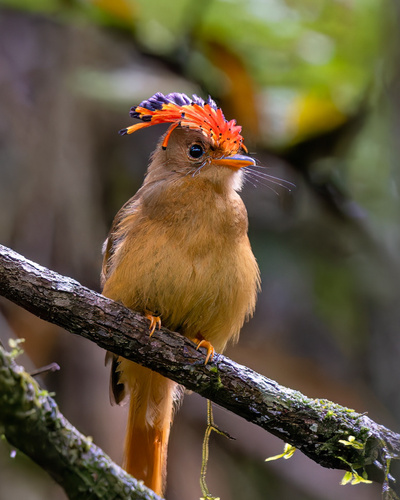
Side by side: Ruddy-tailed Flycatcher vs Tropical Royal Flycatcher
Learn the Tropical Royal Flycatcher in the BeakBrain App
Photo and call practice. Coming soon to iPhone and Android.
Play today's Daily BirdEvery photo and recording on this page is credited to its author under the licence shown. Spotted a problem with this page, or have a better photo? Contribute.