Learn what every symbol on the card means.Full credits and sources at beakbrain.com/symbols
 CoastalPlatform nestLarge · 372 g



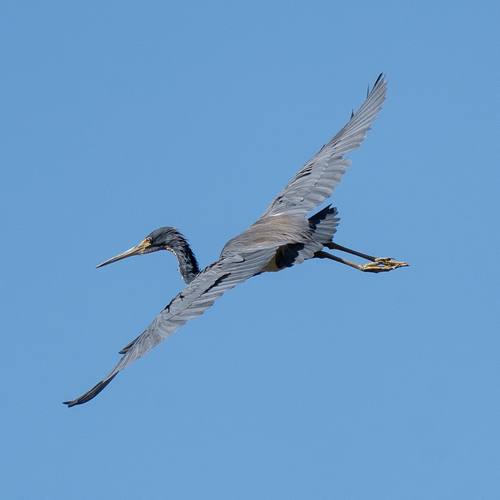
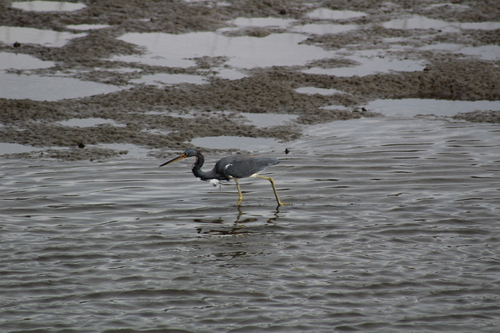
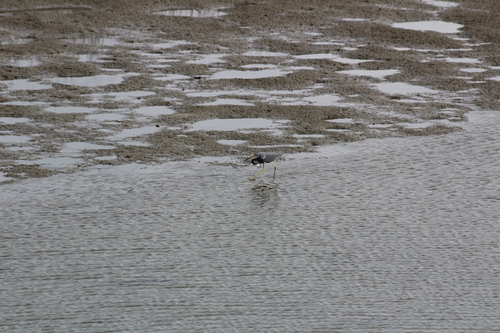
ID tip
This species measures from 56 to 76 cm (22 to 30 in) long and has a typical wingspan of 96 cm (38 in). The slightly larger male heron weighs 415 g (14.6 oz) on average, while the female averages 334 g (11.8 oz). It is a medium-large, long-legged, long-necked heron with a long, pointed, yellowish or greyish bill with a black tip. In breeding plumage, some individuals will develop a stark bicolored bill which is blue and black at the tip. Its legs and feet turn from dark yellow in nonbreeding birds to pink in breeding adults.
Text from Wikipedia, licensed CC BY-SA 4.0.
When to see the Tricolored Heron
One bar for each month, and every month is filled: this bird is recorded here in all twelve. The wide bar is April, the month with the most records.
Where to see the Tricolored Heron
The map shades 47 countries with regular records, and 4 more in a lighter tone where the bird turns up only as a stray. Everything unshaded has no records. Countries are listed below the map.
Recorded as a rare visitor in France, Portugal, Spain, Montserrat.
About the Tricolored Heron
The tricolored heron, formerly known as the Louisiana heron, is a small species of heron native to coastal parts of the Americas. The species is more solitary than other species of heron in the Americas and eats a diet consisting mostly of small fish.
Text adapted from Wikipedia, licensed CC BY-SA 4.0.
Easily confused with
 Little Blue HeronEgretta caeruleaMales and females have the same coloration.
 White-faced HeronEgretta novaehollandiaeThe adult white-faced heron is medium-sized for the family and mostly pale blue-grey.
 Reddish EgretEgretta rufescensThis species reaches 68–82 cm (27–32 in) in length, with a 116–125 cm (46–49 in) wingspan.
Side by side: Snowy Egret vs Tricolored Heron · Little Egret vs Tricolored Heron · Little Blue Heron vs Tricolored Heron · Tricolored Heron vs White-faced Heron · Reddish Egret vs Tricolored Heron
Learn the Tricolored Heron in the BeakBrain App
Photo and call practice. Coming soon to iPhone and Android.
Play today's Daily BirdEvery photo and recording on this page is credited to its author under the licence shown. Spotted a problem with this page, or have a better photo? Contribute.