Learn what every symbol on the card means.Full credits and sources at beakbrain.com/symbols
 ForestTiny · 7 g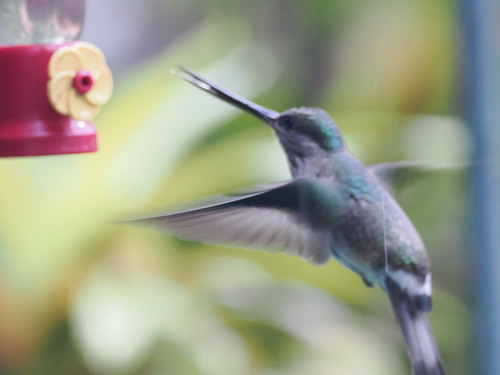
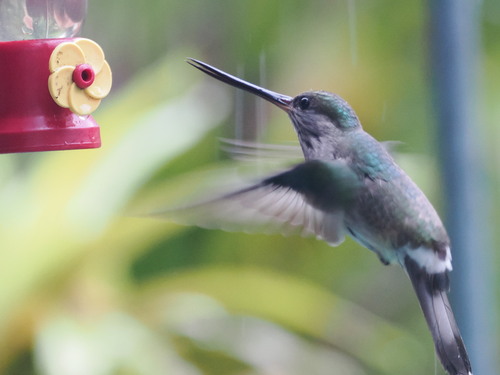
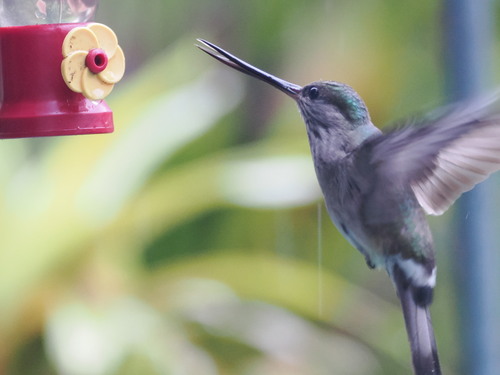
ID tip
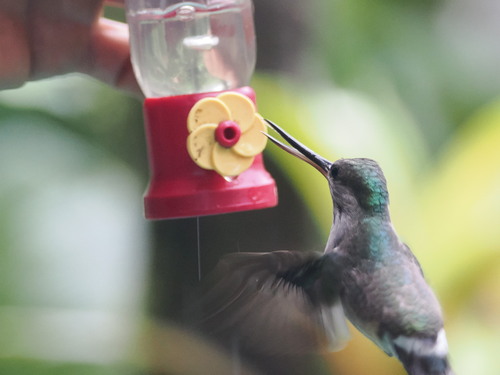
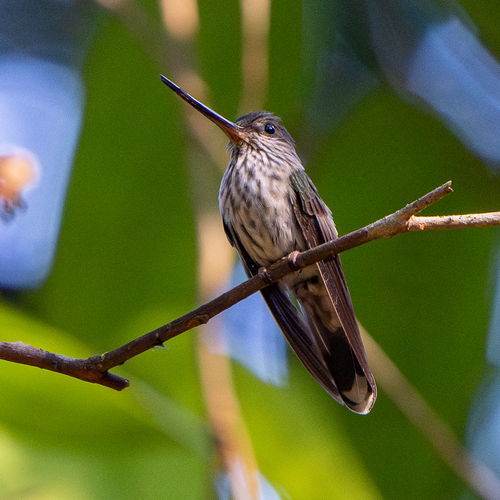
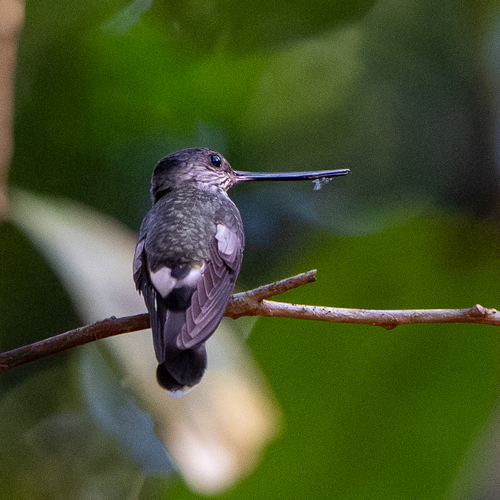
The tooth-billed hummingbird has a total length of c. 14 cm (5+1⁄2 in), which includes the long, essentially straight bill of c. 4 cm (1+1⁄2 in). Its common name refers to the small tooth-like serrations on the inner part of the distal half of the bill. It is shiny green above with a coppery crown. The underparts are whitish streaked dusky. The rounded tail is greyish with a broad black subterminal band and white tips. There is a conspicuous white band on the rump.
Text from Wikipedia, licensed CC BY-SA 4.0.
When to see the Tooth-billed Hummingbird
One bar for each month, and every month is filled: this bird is recorded here in all twelve. The wide bar is May, the month with the most records.
Where to see the Tooth-billed Hummingbird
The map shades 3 countries with regular records. Everything unshaded has no records. Countries are listed below the map.
About the Tooth-billed Hummingbird
The tooth-billed hummingbird is a species of bird from the family Trochilidae. It is monotypic within the genus Androdon. It is found in humid forests in western Colombia, north-western Ecuador, and far eastern Panama. While generally scarce, localized and associated with the highly threatened humid sections of the Chocó, its range remains relatively large, and it is therefore considered to be of least concern by BirdLife International.
Text adapted from Wikipedia, licensed CC BY-SA 4.0.
Easily confused with
 Sparkling-tailed WoodstarTilmatura dupontiiMale sparkling-tailed woodstars are 8.2 to 10.1 cm (3.2 to 4.0 in) long.
 Stripe-breasted StarthroatHeliomaster squamosusThe stripe-breasted starthroat is 11.2 to 12.4 cm (4.4 to 4.9 in) long and weighs 5 to 6.5 g (0.18 to 0.23 oz).
 Blue-throated StarfrontletCoeligena heliantheaThe blue-throated starfrontlet is about 13 cm (5.1 in) long.
Side by side: Blue-throated Starfrontlet vs Tooth-billed Hummingbird · Sparkling-tailed Woodstar vs Tooth-billed Hummingbird · Stripe-breasted Starthroat vs Tooth-billed Hummingbird
Learn the Tooth-billed Hummingbird in the BeakBrain App
Photo and call practice. Coming soon to iPhone and Android.
Play today's Daily BirdEvery photo and recording on this page is credited to its author under the licence shown. Spotted a problem with this page, or have a better photo? Contribute.