Learn what every symbol on the card means.Full credits and sources at beakbrain.com/symbols
 RiverineTiny · 15 g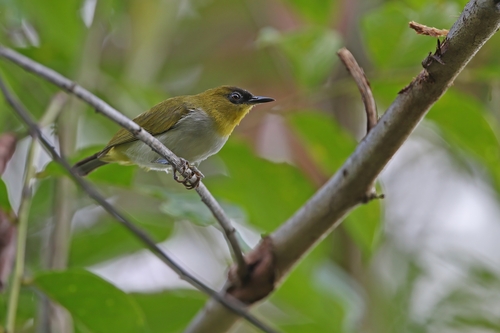
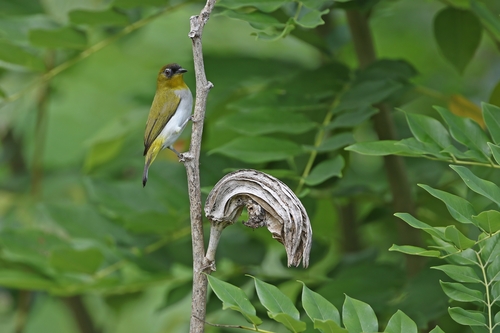
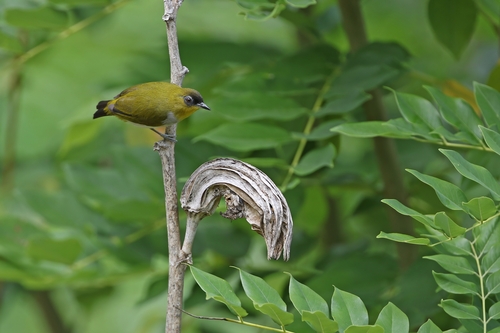


ID tip
The Sulawesi region is believed to have at least 9-10 species that are found in isolated islands. This isolation has led to speciation with differences in morphology and vocalizations. This new species is most similar to the black-crowned white-eye (Zosterops atrifrons) but lacks the white eye ring which is narrow but conspicuous even in juvenile black-crowned white-eyes. The Togian white-eye has a less extensive black cap, clearer yellow throat, distinct pale base to the bill and reddish (brown in the black-crowned) iris.
Text from Wikipedia, licensed CC BY-SA 4.0.
When to see the Togian White-eye
One bar for each month. Filled bars are the 4 months with records; pale bars are months with none. The wide bar is December, the month with the most records.
Where to see the Togian White-eye
The map shades 1 country with regular records. Everything unshaded has no records. Countries are listed below the map.
About the Togian White-eye
The Togian white-eye is a species of bird in the family Zosteropidae.
Text adapted from Wikipedia, licensed CC BY-SA 4.0.
Easily confused with
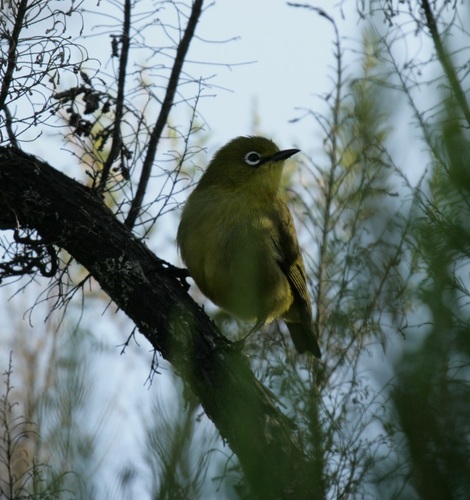 Karthala White-eyeZosterops mouroniensisThe Karthala white-eye, also known as the Mount Karthala white-eye, Grand Comore white-eye, or Comoro white-eye, is a species of bird in the family Zosteropidae.
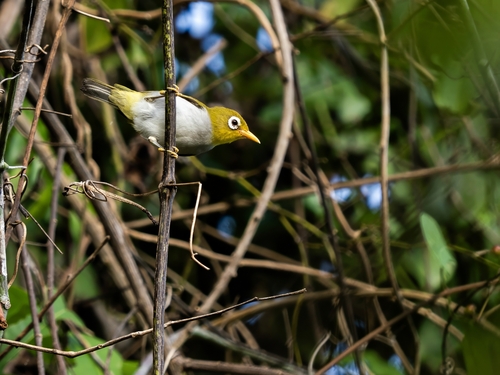 Wangi-wangi White-eyeZosterops paruhbesarThe Wangi-wangi white-eye, locally known as sui, is a species of songbird in the white-eye family.
Learn the Togian White-eye in the BeakBrain App
Photo and call practice. Coming soon to iPhone and Android.
Play today's Daily BirdEvery photo and recording on this page is credited to its author under the licence shown. Spotted a problem with this page, or have a better photo? Contribute.