Learn what every symbol on the card means.Full credits and sources at beakbrain.com/symbols
 GrasslandScrapeLarge · 1.5 kg
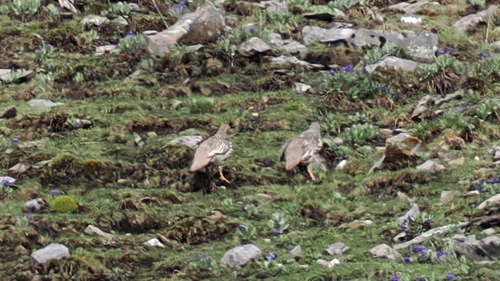
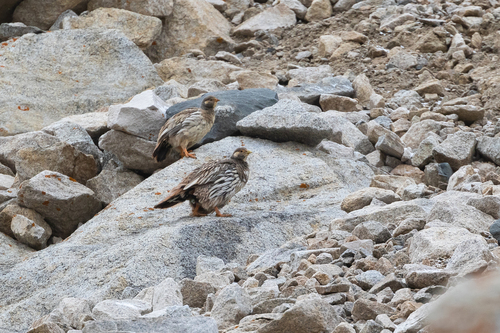
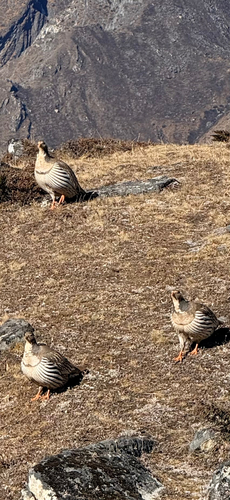
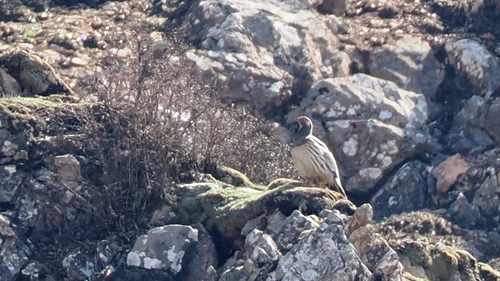
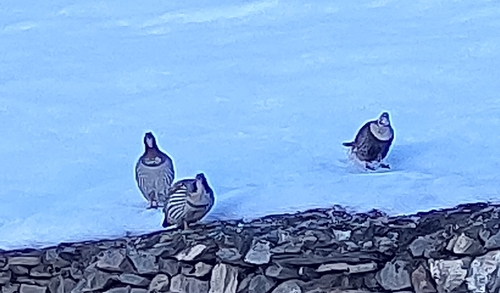
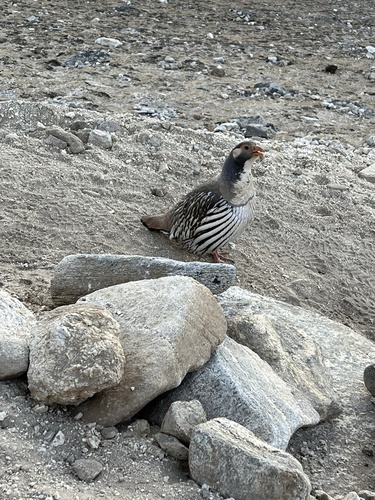
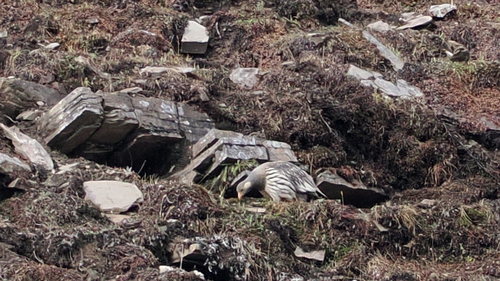
ID tip
Smaller than Himalayan snowcock, this species has a grey head and neck with a white patch behind the eye and above the dark cheek. Chin, throat and breast are white, with two grey bands on the breast. Grey wing coverts and tertials have a white trim. The secondaries have a broad white trailing edge that forms a wing band. Underparts are white with black streaks on flanks and belly. The tail is rufous brown and the undertail coverts are black. Legs and beaks are reddish.
Text from Wikipedia, licensed CC BY-SA 4.0.
When to see the Tibetan Snowcock
One bar for each month. Filled bars are the 8 months with records; pale bars are months with none. The wide bar is May, the month with the most records.
Where to see the Tibetan Snowcock
The map shades 4 countries with regular records. Everything unshaded has no records. Countries are listed below the map.
About the Tibetan Snowcock
The Tibetan snowcock is a bird in the pheasant family Phasianidae of the order Galliformes, gallinaceous birds. This species is found in high-altitude regions of the Western Himalayas and the Tibetan Plateau, where it overlaps in part with the larger Himalayan snowcock. The head is greyish and there is a white crescent patch behind the eye and underside is white with black stripes. In flight the secondaries show a broad white trailing edge.
Text adapted from Wikipedia, licensed CC BY-SA 4.0.
Easily confused with
 Caucasian SnowcockTetraogallus caucasicusThis is a 50–60 cm (20–24 in) long bird.
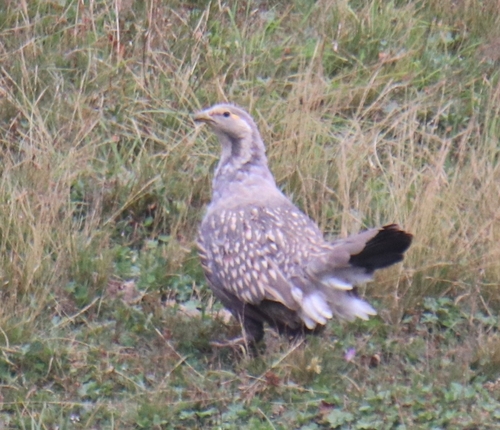 Caspian SnowcockTetraogallus caspiusThis snowcock ranges from 56 to 63 cm (22 to 25 in) in length, 95 to 105 cm (37 to 41 in) in wingspan and 1.8 to 2.9 kg (4.0 to 6.4 lb) in weight.
 Himalayan SnowcockTetraogallus himalayensisThe Himalayan snowcock is a large grey partridge-like bird, 55–74 cm (22–29 in) in length and weighing 2–3.1 kg (4.4–6.8 lb).
Learn the Tibetan Snowcock in the BeakBrain App
Photo and call practice. Coming soon to iPhone and Android.
Play today's Daily BirdEvery photo and recording on this page is credited to its author under the licence shown. Spotted a problem with this page, or have a better photo? Contribute.