Learn what every symbol on the card means.Full credits and sources at beakbrain.com/symbols
 ForestScrapeHuge · 2.1 kg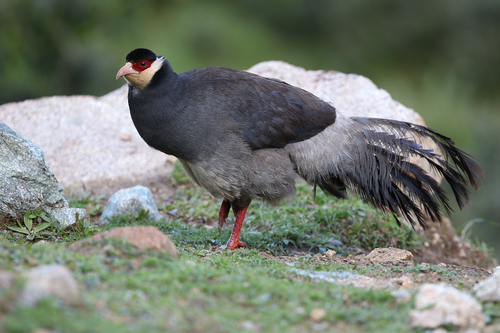




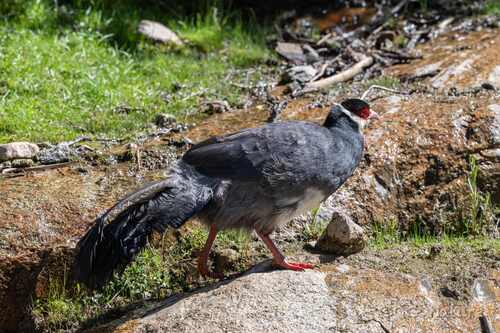



ID tip
The Tibetan eared pheasant shares many characteristics, such as the short ears and the droopy tail, with the white eared pheasant (C. crossoptilon), as well as having similar calls and hybridising with it in the Salween Valley, so the two may be conspecific. The Tibetan eared pheasant grows to a length between 75 and 85 cm (30 and 33 in), with females being slightly smaller than males. The sexes are similar. The beak is reddish-brown, the irises yellowish-orange, and the bare facial skin is red, as are the legs.
Text from Wikipedia, licensed CC BY-SA 4.0.
When to see the Tibetan Eared Pheasant
One bar for each month. Filled bars are the 9 months with records; pale bars are months with none. The wide bar is October, the month with the most records.
Where to see the Tibetan Eared Pheasant
The map shades 1 country with regular records, and 1 more in a lighter tone where the bird turns up only as a stray. Everything unshaded has no records. Countries are listed below the map.
Recorded as a rare visitor in India.
About the Tibetan Eared Pheasant
The Tibetan eared pheasant, also called Elwes' eared pheasant, is a species of bird in the family Phasianidae found in southeast Tibet and adjacent northern India, usually between 3,000 and 5,000 m elevation, but has been seen down to 2,280 m (7,500 ft) in winter. The species is named after Henry John Harman.
Text adapted from Wikipedia, licensed CC BY-SA 4.0.
Easily confused with
 Brown Eared PheasantCrossoptilon mantchuricumThe crown feathers are velvety and dark brown, and the neck is also dark brown with a faint, narrow white band across the nape.
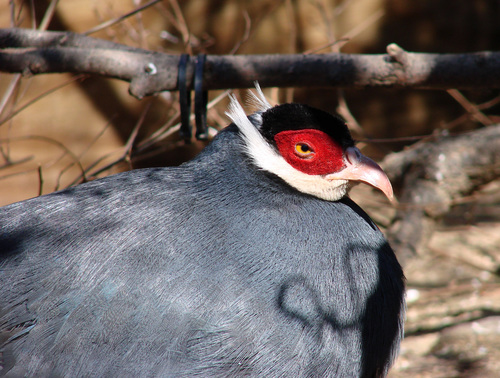 Blue Eared PheasantCrossoptilon auritumThe blue eared pheasant is around 96 cm (38 in) long (including the 49–56 cm (19–22 in) tail); males weigh 1700–2110 g, and females 1450–1880 g.
 White Eared PheasantCrossoptilon crossoptilonThe white eared pheasant, also known as Dolan's eared pheasant or Bee's pheasant, is a species of "eared pheasant" that get its name because its colouration is white and has the prominent ear tufts of the genus, not because it has white ears.
Learn the Tibetan Eared Pheasant in the BeakBrain App
Photo and call practice. Coming soon to iPhone and Android.
Play today's Daily BirdEvery photo and recording on this page is credited to its author under the licence shown. Spotted a problem with this page, or have a better photo? Contribute.