Learn what every symbol on the card means.Full credits and sources at beakbrain.com/symbols
 ForestCup nestSmall · 52 g
ID tip
The tepui antpitta is about 16 cm (6.3 in) long; four males weighed between 40.5 and 53 g (1.4 and 1.9 oz) and two females 51.8 and 53 g (1.8 and 1.9 oz). The sexes have the same plumage and the subspecies differ little from each other. Adults of the nominate subspecies M. s. simplex have a small white spot behind their eye. Most of the rest of their face is chestnut-brown with slightly paler and grayer lores. Their crown, nape, upperparts, wings, and tail are chestnut-brown. Their chin and throat are white. Their breast, sides, and flanks are olivaceous gray or gray with an olive-brown wash. Voice: The tepui antpitta's song is "6-7 (occasionally more) low-pitched, deliberately paced, hollow notes, whu-whu-whu-WU-hu-hu, 1st ones rising slightly in pitch and increasing in volume, last 2-3 on same pitch". It also "gives a low, hollow, rattle-trill".
Text from Wikipedia, licensed CC BY-SA 4.0.
When to see the Tepui Antpitta
One bar for each month. Filled bars are the 9 months with records; pale bars are months with none. The wide bar is February, the month with the most records.
Where to see the Tepui Antpitta
The map shades 2 countries with regular records, and 1 more in a lighter tone where the bird turns up only as a stray. Everything unshaded has no records. Countries are listed below the map.
Recorded as a rare visitor in Brazil.
About the Tepui Antpitta
The tepui antpitta or brown-breasted antpitta is a species of bird in the family Grallariidae. It is found in Brazil, Guyana, and Venezuela.
Text adapted from Wikipedia, licensed CC BY-SA 4.0.
Easily confused with
 White-lored AntpittaMyrmothera fulviventrisThe white-lored antpitta is 14 to 15 cm (5.5 to 5.9 in) long; three individuals weighed between 44 and 55 g (1.6 and 1.9 oz).
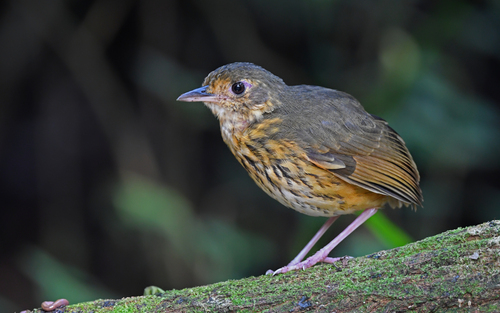 Amazonian AntpittaMyrmothera berlepschiThe Amazonian antpitta is 14.5 to 15 cm (5.7 to 5.9 in) long; males weigh 46 to 54 g (1.6 to 1.9 oz) and females 36 to 49 g (1.3 to 1.7 oz).
Learn the Tepui Antpitta in the BeakBrain App
Photo and call practice. Coming soon to iPhone and Android.
Play today's Daily BirdEvery photo and recording on this page is credited to its author under the licence shown. Spotted a problem with this page, or have a better photo? Contribute.