Learn what every symbol on the card means.Full credits and sources at beakbrain.com/symbols
 ForestCavity nestSmall · 55 g

ID tip
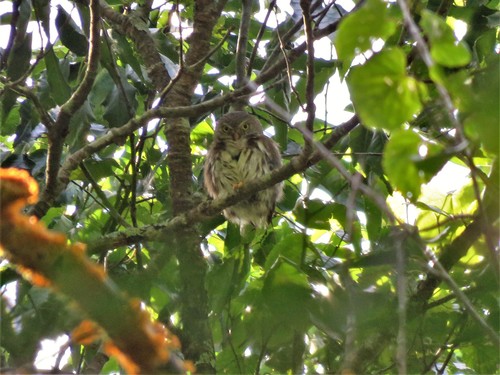
The adult Tamaulipas pygmy owl has a length of between 13 and 16 cm (5.1 and 6.3 in) with a relatively long tail of between 5.1 and 5.7 cm (2.0 and 2.2 in). Their average weight is 53 g (1.9 oz), the male generally being lighter than the female. The male has a brownish facial disc flecked with white and short white eyebrows. The upper parts are olive-brown, with a greyer crown and fine white speckling at the front and sides of the crown. The main wing and tail feathers are barred in white. The underparts are whitish with some reddish-brown streaking and mottling.
Text from Wikipedia, licensed CC BY-SA 4.0.
When to see the Tamaulipas Pygmy Owl
One bar for each month, and every month is filled: this bird is recorded here in all twelve. The wide bar is June, the month with the most records.
Where to see the Tamaulipas Pygmy Owl
The map shades 1 country with regular records. Everything unshaded has no records. Countries are listed below the map.
About the Tamaulipas Pygmy Owl
The Tamaulipas pygmy owl is a species of owl in the family Strigidae. It is endemic to Mexico. This is one of the smallest owls in the world, with a mean length of 13.5 cm (5.3 in). However, at 53 g (1.9 oz), it is slightly heavier than the long-whiskered owlet and the elf owl. Its natural habitat is subtropical or tropical moist montane forests.
Text adapted from Wikipedia, licensed CC BY-SA 4.0.
Easily confused with
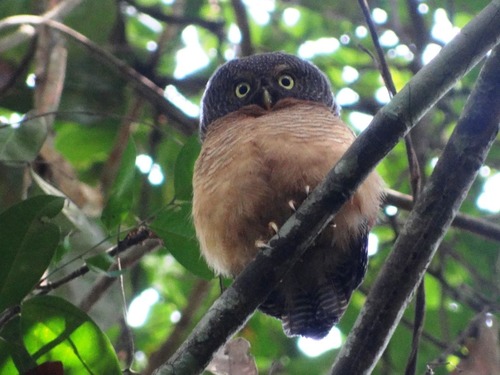 Sjöstedt's Barred OwletGlaucidium sjostedtiSjöstedt's barred owlet is a small owl, which has a brown head, neck and upper back densely marked with thin, white bars, while the remainder of the upperparts are deep reddish brown.
 Subtropical Pygmy OwlGlaucidium parkeriThe subtropical pygmy owl is about 14 to 14.5 cm (5.5 to 5.7 in) long; three males had an average weight of 61.6 g (2.17 oz).
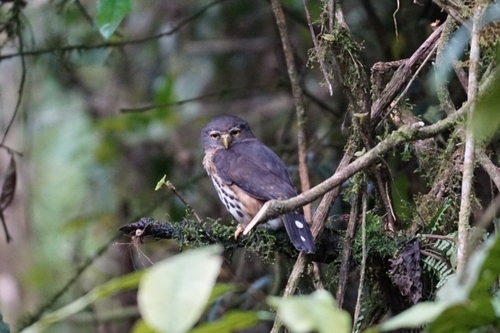 Red-chested OwletGlaucidium tephronotumThe red-chested owlet is a very small owl, which has a light grey facial disc with whitish markings and short white eyebrows.
Learn the Tamaulipas Pygmy Owl in the BeakBrain App
Photo and call practice. Coming soon to iPhone and Android.
Play today's Daily BirdEvery photo and recording on this page is credited to its author under the licence shown. Spotted a problem with this page, or have a better photo? Contribute.