Learn what every symbol on the card means.Full credits and sources at beakbrain.com/symbols
 ForestCup nestMedium · 69 g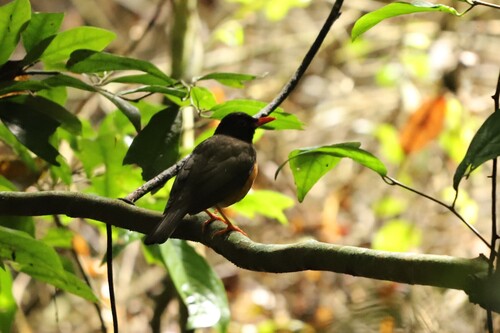

ID tip
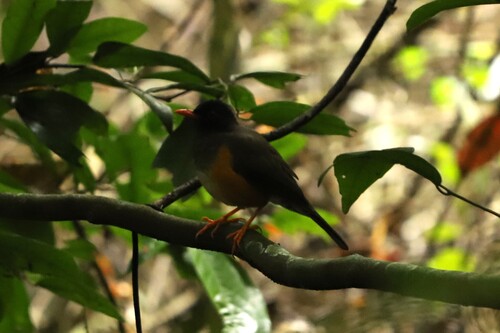
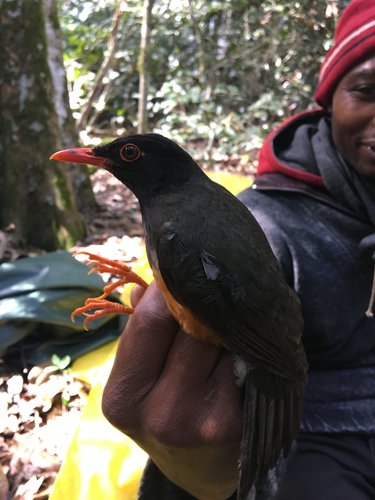
The Taita thrush was previously classified as subspecies of the olive thrush (Turdus olivaceus), but it is now treated as distinct species. It reaches a length between 20 and 22 centimetres. The head and upperparts are dark grey-brown to black, the breast is grey, the underparts are white, and the flanks are rufous-red. The eye is dark with a narrow yellow or orange eye-ring, and the bill and legs are bright orange. It was named after the zoologist Edmund Heller (1875–1939), a workmate of the American ornithologist Edgar Alexander Mearns (1856–1916) who first described this species in 1913.
Text from Wikipedia, licensed CC BY-SA 4.0.
When to see the Taita Thrush
One bar for each month. Filled bars are the 11 months with records; pale bars are months with none. The wide bar is November, the month with the most records.
Where to see the Taita Thrush
The map shades 1 country with regular records. Everything unshaded has no records. Countries are listed below the map.
About the Taita Thrush
The Taita thrush, also known as the Taita olive thrush or Heller's ground thrush, is an endangered bird in the thrush family Turdidae, endemic to the Taita Hills in southern Kenya.
Text adapted from Wikipedia, licensed CC BY-SA 4.0.
Easily confused with
 Usambara ThrushTurdus roehliThis medium-sized bird has a length of about 24 cm.
 Sulawesi ThrushTurdus turdoidesThe Sulawesi thrush is a medium-sized species with a long beak, short rounded wings and robust legs.
Comoro ThrushTurdus bewsheriThe Comoro thrush is a brown bird with olive tinged upperparts, slightly more rufous on the tail and wings.
Sulawesi ThrushTurdus turdoidesThe Sulawesi thrush is a medium-sized species with a long beak, short rounded wings and robust legs.
Comoro ThrushTurdus bewsheriThe Comoro thrush is a brown bird with olive tinged upperparts, slightly more rufous on the tail and wings.
Learn the Taita Thrush in the BeakBrain App
Photo and call practice. Coming soon to iPhone and Android.
Play today's Daily BirdEvery photo and recording on this page is credited to its author under the licence shown. Spotted a problem with this page, or have a better photo? Contribute.