Learn what every symbol on the card means.Full credits and sources at beakbrain.com/symbols
 MarineCavity nestLarge · 409 g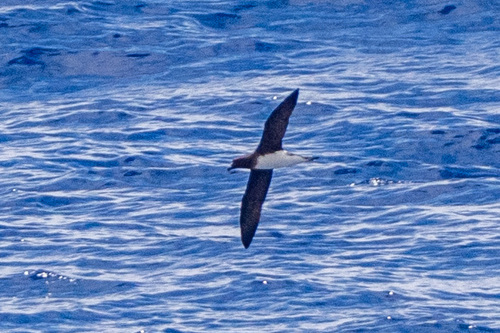


ID tip
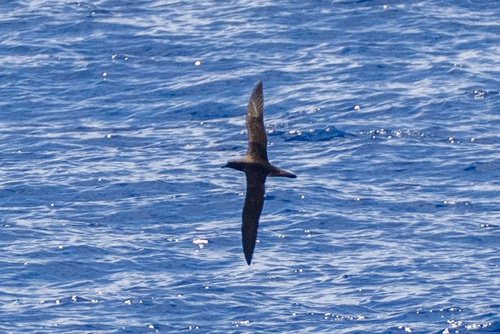
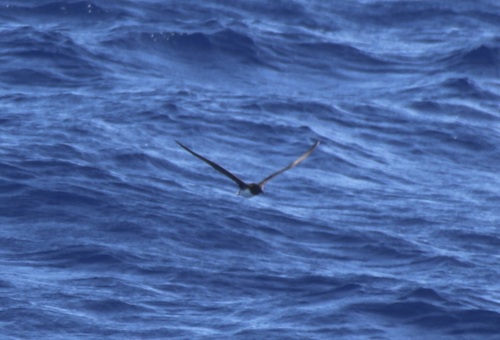
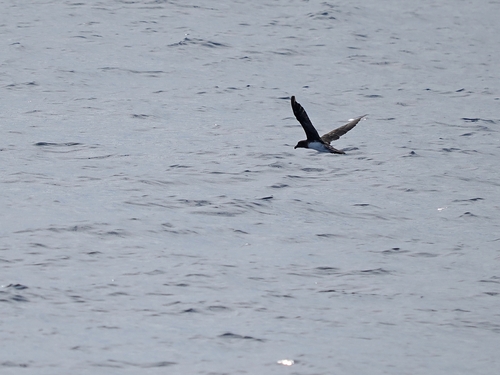
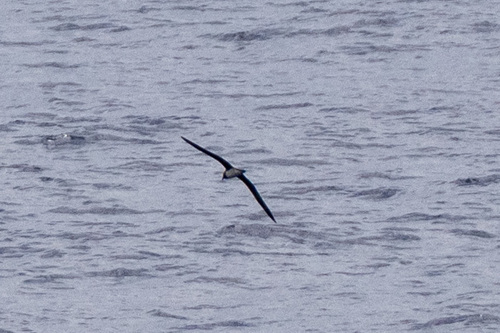
Adult Tahiti petrels are between 315 and 506 g and have wingspans averaging 104.5 cm long whereas their overall length is between 38-42 cm. The species is identifiable by its wedge-shaped tail, long wings and neck, small head, black, stout, and bulbous bill, dark brown eyes, and dark elongated body with white abdomen. In addition, adults are mostly dark brown with darker hoods and paler rumps. Their underwings have a faint white line along the middle with slightly paler flight feathers. Juveniles are similar to adults in plumage and females usually have smaller measurements. Voice: When in flight or on its breeding ground, P. r. rostrata uses a long series of whistles in an elaborate call ending with a hooting sound. Specifically in American Samoa, P. r. rostrata vocalization was described as a ground call composed of 7 parts, uttering a condensed version when in flight. The introductory "ti-ti" call is a series of staccato notes observed in 20 other petrel species.
Text from Wikipedia, licensed CC BY-SA 4.0.
When to see the Tahiti Petrel
One bar for each month. Filled bars are the 10 months with records; pale bars are months with none. The wide bar is November, the month with the most records.
Where to see the Tahiti Petrel
The map shades 20 countries with regular records, and 7 more in a lighter tone where the bird turns up only as a stray. Everything unshaded has no records. Countries are listed below the map.
Recorded as a rare visitor in United States, Colombia, South Africa, New Zealand, Micronesia, Oman, Niue.
About the Tahiti Petrel
The Tahiti petrel is a medium-sized, dark brown and white seabird found across the Pacific Ocean. The species comprises two subspecies: P. r. rostrata which breeds in the west-central Pacific Ocean, and P. r. trouessarti which breeds in the tropical and subtropical Pacific Ocean. The Tahiti petrel belongs to the Procellariidae family and is the most studied member of the Pseudobulweria genus which comprises three critically endangered species. Similarly, the Tahiti petrel is considered near threatened by the 2018 IUCN Red List of Threatened Species. Threats include introduced rats, feral cats, pigs, dogs, nickel mining, and light pollution.
Text adapted from Wikipedia, licensed CC BY-SA 4.0.
Easily confused with
 Mascarene PetrelPseudobulweria aterrimaThe Mascarene petrel is a medium-sized, dark petrel.
Beck's PetrelPseudobulweria beckiIt is dark brown above and on the head and throat.
Fiji PetrelPseudobulweria macgillivrayiThe Fiji petrel, also known as MacGillivray's petrel, is a small, dark gadfly petrel.
Mascarene PetrelPseudobulweria aterrimaThe Mascarene petrel is a medium-sized, dark petrel.
Beck's PetrelPseudobulweria beckiIt is dark brown above and on the head and throat.
Fiji PetrelPseudobulweria macgillivrayiThe Fiji petrel, also known as MacGillivray's petrel, is a small, dark gadfly petrel.
Learn the Tahiti Petrel in the BeakBrain App
Photo and call practice. Coming soon to iPhone and Android.
Play today's Daily BirdEvery photo and recording on this page is credited to its author under the licence shown. Spotted a problem with this page, or have a better photo? Contribute.