Learn what every symbol on the card means.Full credits and sources at beakbrain.com/symbols
 ForestCup nestSmall · 16 g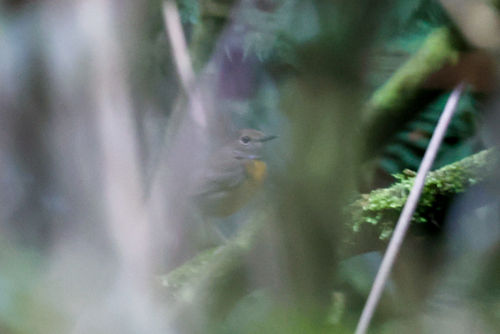

ID tip
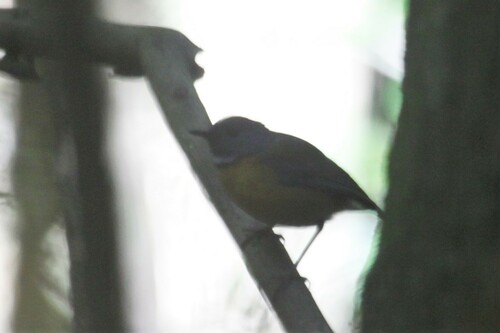
Swynnerton's robin is superficially similar to the larger White-starred robin, but has a white crescent on the upper breast, which is bordered below with a black line, and its grey tail lacks yellow windows. Its sexually dimorphic plumage is unusual among African robins. The female has duller plumage and an olive wash over the crown and face. Juveniles are spotted buffy yellow on the head and upper parts, while the chest crescent is pale greyish brown. This species has a length of 13 to 14 cm (5.1 to 5.5 in). Voice: Swynnerton's robin has a song which has been described as a 3 note whistle, rendered as "zit zitt slurr" or "tsee-tuu-tuu". The third note may be lower in pitch than the preceding 2. The alarm call is a quiet chattering "trrrrrt".
Text from Wikipedia, licensed CC BY-SA 4.0.
When to see the Swynnerton's Robin
One bar for each month. Filled bars are the 11 months with records; pale bars are months with none. The wide bar is January, the month with the most records.
Where to see the Swynnerton's Robin
The map shades 3 countries with regular records, and 1 more in a lighter tone where the bird turns up only as a stray. Everything unshaded has no records. Countries are listed below the map.
Recorded as a rare visitor in South Africa.
About the Swynnerton's Robin
Swynnerton's robin is a species of passerine bird belonging to the family Muscicapidae. It is monotypic within the genus Swynnertonia. The common and Latin names commemorate the entomologist Charles Swynnerton.
Text adapted from Wikipedia, licensed CC BY-SA 4.0.
Easily confused with
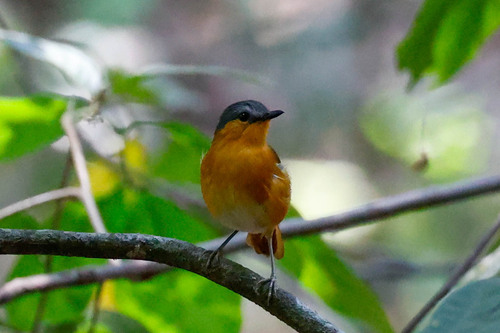 Bocage's AkalatSheppardia bocageiBocage's akalat is a species of bird in the family Muscicapidae.
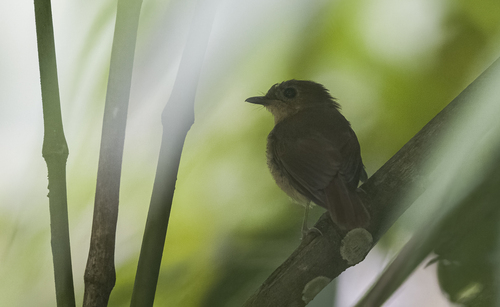 Cryptic FlycatcherFicedula cryptaIts drab colour, low foraging areas and its habit of being perched motionless most likely makes this bird overlooked and unnoticed.
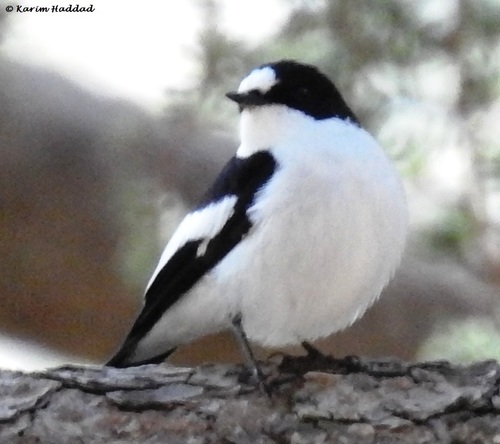 Atlas Pied FlycatcherFicedula speculigeraThe Atlas pied flycatcher or Atlas flycatcher is a bird in an Old World flycatcher family, one of the four species of Western Palearctic black-and-white flycatchers; it is endemic as a breeding species to North-west Africa.
Learn the Swynnerton's Robin in the BeakBrain App
Photo and call practice. Coming soon to iPhone and Android.
Play today's Daily BirdEvery photo and recording on this page is credited to its author under the licence shown. Spotted a problem with this page, or have a better photo? Contribute.