Learn what every symbol on the card means.Full credits and sources at beakbrain.com/symbols
 GrasslandCup nestSmall · 19 g
ID tip
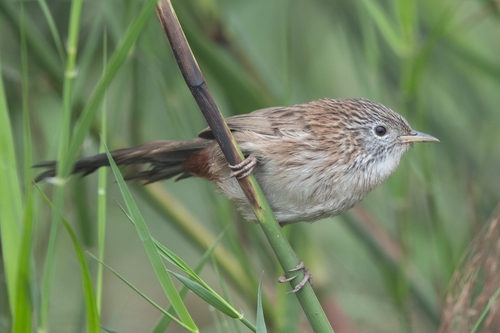
Swamp grass babblers average 17 cm (6.7 in) long (big for a prinia). Adults are olive-grey above, slightly warmer on the back of the neck and upper back, but less distinctly collared than the rufous-vented grass babbler. Bold dark streaking starts at the forehead and fades on the back. The underparts are greyish white, greyer on the flanks, which may be slightly streaked. There is a faint buff tint to the undertail coverts (but not the distinctive colouring for which the rufous-vented prinia is named).
Text from Wikipedia, licensed CC BY-SA 4.0.
When to see the Swamp Grass Babbler
One bar for each month. Filled bars are the 7 months with records; pale bars are months with none. The wide bar is January, the month with the most records.
Where to see the Swamp Grass Babbler
The map shades 1 country with regular records. Everything unshaded has no records. Countries are listed below the map.
About the Swamp Grass Babbler
The swamp grass babbler or swamp prinia is a small bird of the Indian subcontinent. Some authorities consider it a subspecies of the rufous-vented grass babbler.
Text adapted from Wikipedia, licensed CC BY-SA 4.0.
Easily confused with
Learn the Swamp Grass Babbler in the BeakBrain App
Photo and call practice. Coming soon to iPhone and Android.
Play today's Daily BirdEvery photo and recording on this page is credited to its author under the licence shown. Spotted a problem with this page, or have a better photo? Contribute.