Learn what every symbol on the card means.Full credits and sources at beakbrain.com/symbols
 ShrublandCup nestTiny · 9 g


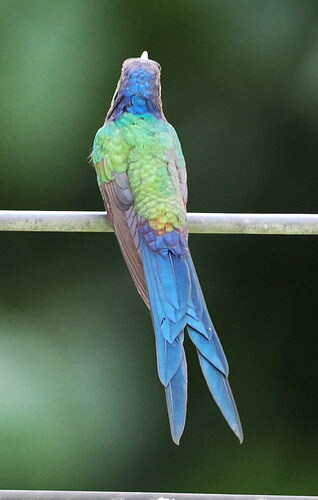
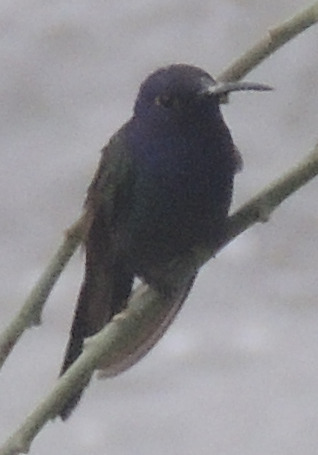
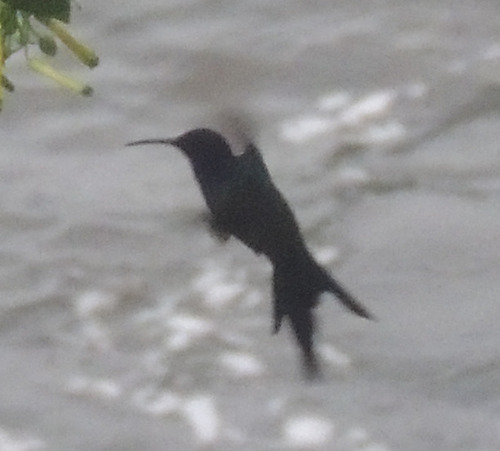
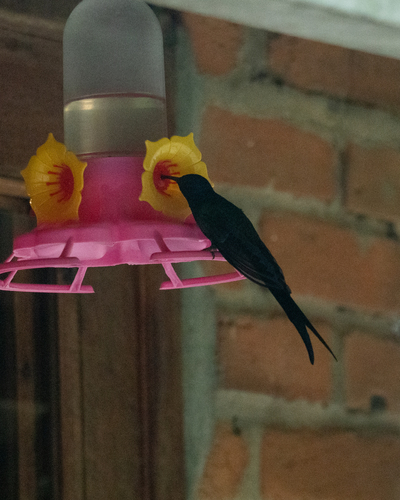
ID tip
With a total length of 15–17 cm (6–6+1⁄2 in), nearly half of which is made up by the tail, and weighing up to 9 g (0.32 oz), this is a relatively large hummingbird. Indeed, in much of its range it is the largest species of typical hummingbird. Its wings are also nearly 8 cm long – quite much for its size by hummingbird standards – though its bill is only of mediocre length, with c. 21 mm (0.83 in) not longer in absolute terms than that of many smaller relatives. Its plumage is brilliant iridescent green, with a blue head, upper chest, tail and vent.
Text from Wikipedia, licensed CC BY-SA 4.0.
When to see the Swallow-tailed Hummingbird
One bar for each month, and every month is filled: this bird is recorded here in all twelve. The wide bar is October, the month with the most records.
Where to see the Swallow-tailed Hummingbird
The map shades 7 countries with regular records, and 1 more in a lighter tone where the bird turns up only as a stray. Everything unshaded has no records. Countries are listed below the map.
Recorded as a rare visitor in French Guiana.
About the Swallow-tailed Hummingbird
The swallow-tailed hummingbird is a species in the hummingbird family (Trochilidae), found mainly in east-central South America. Most authorities place it in the genus Eupetomena, although some place it in Campylopterus based on song and the thick shafts of the males' first primaries. Its common name and specific epithet both refer to the long, deeply forked, somewhat swallow-like tail.
Text adapted from Wikipedia, licensed CC BY-SA 4.0.
Easily confused with
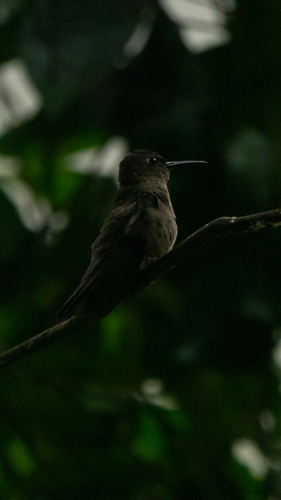
Side by side: Sombre Hummingbird vs Swallow-tailed Hummingbird
Learn the Swallow-tailed Hummingbird in the BeakBrain App
Photo and call practice. Coming soon to iPhone and Android.
Play today's Daily BirdEvery photo and recording on this page is credited to its author under the licence shown. Spotted a problem with this page, or have a better photo? Contribute.