Learn what every symbol on the card means.Full credits and sources at beakbrain.com/symbols
 ForestMedium · 87 g


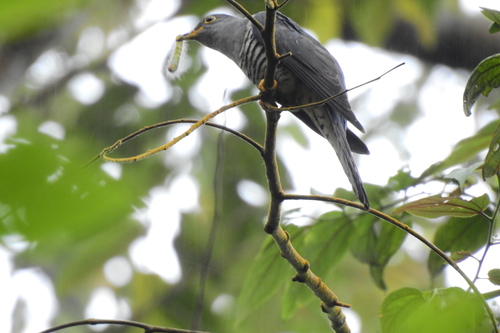
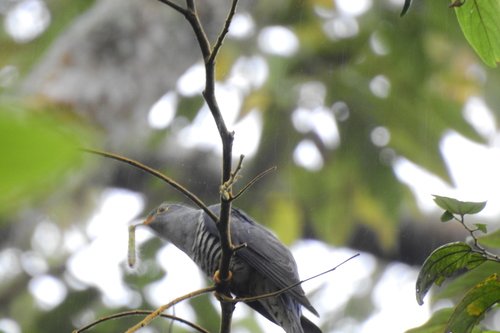
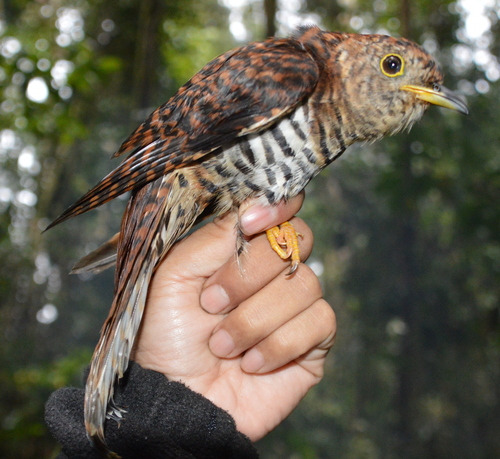
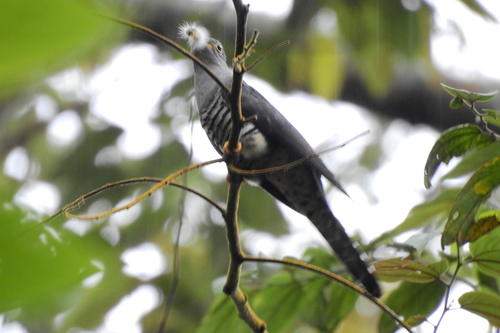
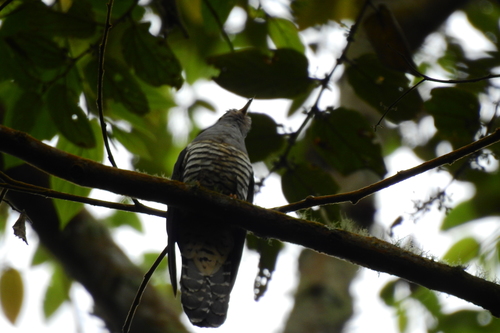
ID tip
It is 29–30 cm long. The upperparts, throat and upper breast are dark grey. The rest of the underparts are buff with black bars. The tail is blackish with white spots. The female also occurs in a rufous form which has reddish-brown upperparts, paler underparts and black barring both above and below. The Himalayan cuckoo and Oriental cuckoo are similar to the Sunda cuckoo but paler with less buff-coloured underparts and narrower black bars. The song of the Sunda cuckoo usually consists of a short first note followed by two or three longer and lower "hoop" notes.
Text from Wikipedia, licensed CC BY-SA 4.0.
When to see the Sunda Cuckoo
One bar for each month. Filled bars are the 10 months with records; pale bars are months with none. The wide bar is May, the month with the most records.
Where to see the Sunda Cuckoo
The map shades 3 countries with regular records, and 1 more in a lighter tone where the bird turns up only as a stray. Everything unshaded has no records. Countries are listed below the map.
Recorded as a rare visitor in Thailand.
About the Sunda Cuckoo
The Sunda cuckoo or Sunda lesser cuckoo is a South-east Asian bird belonging to the genus Cuculus in the cuckoo family, Cuculidae. It was formerly classified with the Himalayan cuckoo and Oriental cuckoo in a single species, C. saturatus, but is now often regarded as a separate species based on differences in voice, size and plumage.
Text adapted from Wikipedia, licensed CC BY-SA 4.0.
Easily confused with
 Madagascar CuckooCuculus rochiiThe Madagascar cuckoo is a small, slim cuckoo, measuring 28 cm (11 in) in length.
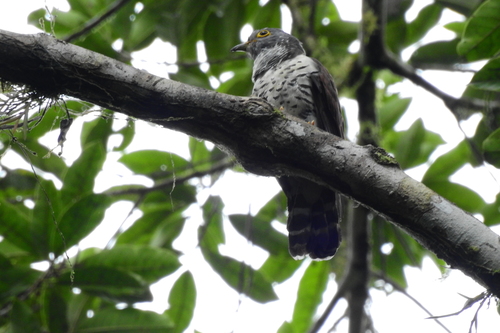 Sulawesi CuckooCuculus crassirostrisThe Sulawesi cuckoo is a species of cuckoo in the family Cuculidae.
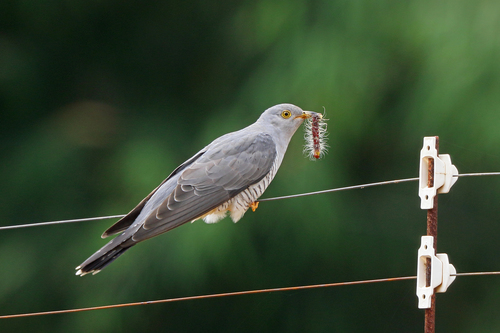 African CuckooCuculus gularisThis is a medium-sized species with a long tail, with a total length of 32 cm (13 in).
Learn the Sunda Cuckoo in the BeakBrain App
Photo and call practice. Coming soon to iPhone and Android.
Play today's Daily BirdEvery photo and recording on this page is credited to its author under the licence shown. Spotted a problem with this page, or have a better photo? Contribute.