Learn what every symbol on the card means.Full credits and sources at beakbrain.com/symbols
 WetlandCup nestMedium · 210 g


What the Sunbittern sounds like

ID tip
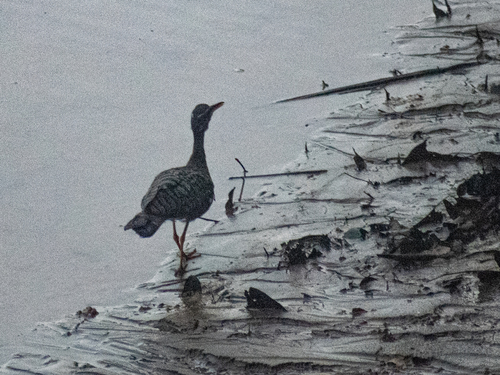
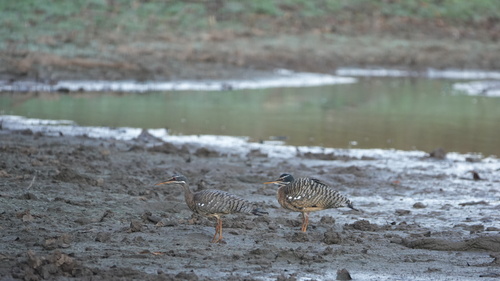
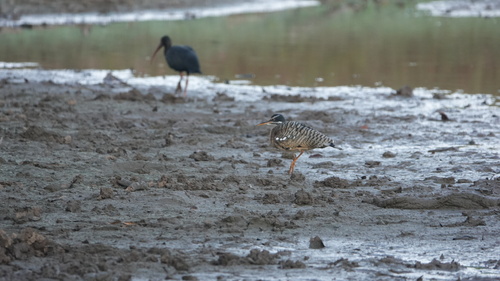
The bird has a generally subdued coloration, with fine linear patterns of black, grey and brown. Its remiges however have vividly colored middle webs, which with wings fully spread show bright eyespots in red, yellow, and black. These are shown to other sunbitterns in courtship and threat displays, or used to startle potential predators. Male and female adult sunbitterns can be differentiated by small differences in the feather patterns of the throat and head. Like some other birds, the sunbittern has powder down.
Text from Wikipedia, licensed CC BY-SA 4.0.
When to see the Sunbittern
One bar for each month, and every month is filled: this bird is recorded here in all twelve. The wide bar is October, the month with the most records.
Where to see the Sunbittern
The map shades 13 countries with regular records, and 1 more in a lighter tone where the bird turns up only as a stray. Everything unshaded has no records. Countries are listed below the map.
Recorded as a rare visitor in Guatemala.
About the Sunbittern
The sunbittern is a bittern-like bird of tropical regions of the Americas, and the sole member of the family Eurypygidae and genus Eurypyga. It is found in Central and South America, and has three subspecies. The sunbittern shows both morphological and molecular similarities with the kagu of New Caledonia, indicating a Gondwanan origin, both species being placed in the clade Eurypygiformes.
Text adapted from Wikipedia, licensed CC BY-SA 4.0.
Learn the Sunbittern in the BeakBrain App
Photo and call practice. Coming soon to iPhone and Android.
Play today's Daily BirdEvery photo and recording on this page is credited to its author under the licence shown. Spotted a problem with this page, or have a better photo? Contribute.