Master this bird in the BeakBrain app to add it to your collection.
Learn what every symbol on the card means.Full credits and sources at beakbrain.com/symbols
Learn what every symbol on the card means.Full credits and sources at beakbrain.com/symbols
LCLeast ConcernInvertebrates UrbanDomed nestSmall · 48 g
UrbanDomed nestSmall · 48 g


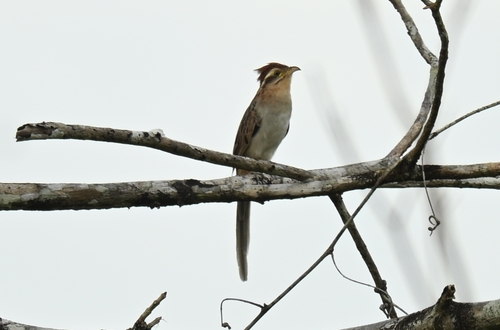
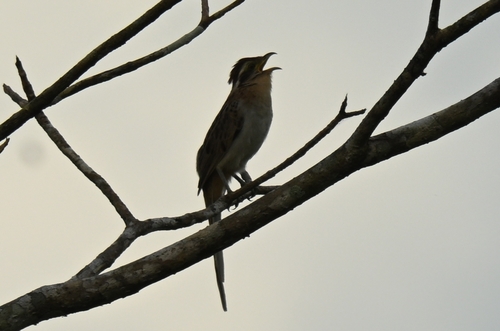

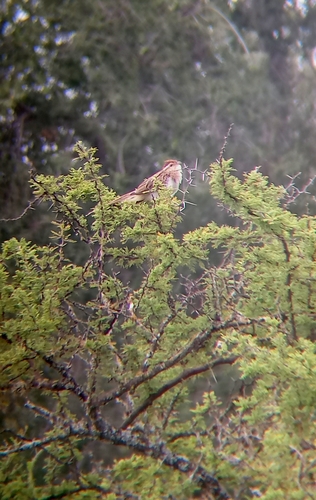
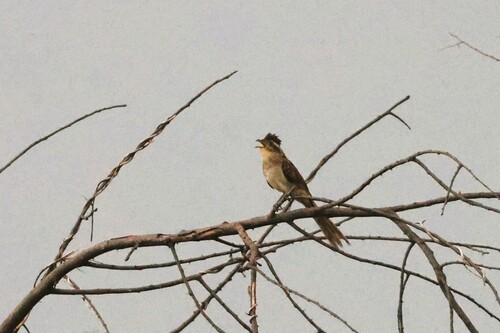
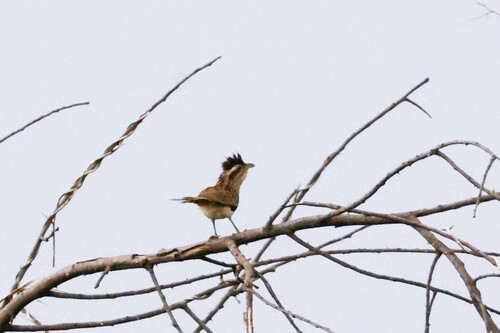
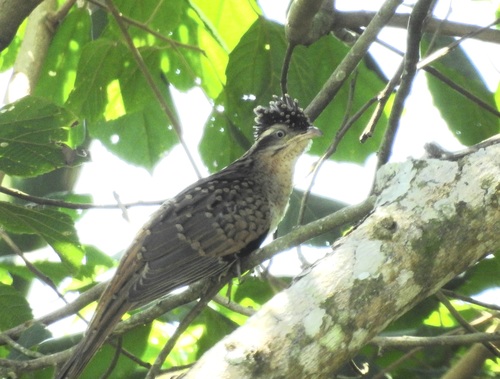
What the Striped Cuckoo sounds like

Recorded by Hugo Oliveros-Salas · Piojó, Atlantico, Colombia · CC0 · via xeno-canto

Recorded by Niels Krabbe · Duet · Azuay: upper Yunguilla Valley, Ecuador · CC BY-SA 4.0 · via xeno-canto

Recorded by Niels Krabbe · Call · Azuay: upper Yunguilla Valley, Ecuador · CC BY-SA 4.0 · via xeno-canto
When to see the Striped Cuckoo
One bar for each month, and every month is filled: this bird is recorded here in all twelve. The wide bar is October, the month with the most records.
Where to see the Striped Cuckoo
Regular range
The map shades 21 countries with regular records. Everything unshaded has no records. Countries are listed below the map.
About the Striped Cuckoo
The striped cuckoo is a near-passerine bird, the only member of the genus Tapera. This resident cuckoo is found from Mexico and Trinidad south to Bolivia and Argentina and Colombia.
Text adapted from Wikipedia, licensed CC BY-SA 4.0.
Easily confused with
 White-browed CoucalCentropus superciliosusThe white-browed coucal is a medium-sized species growing to 36 to 42 cm (14 to 17 in) in length.
 Diederik CuckooChrysococcyx capriusThe diederik cuckoo is a smallish cuckoo at 18 to 20 cm.
 Shining Bronze CuckooChalcites lucidusHard to spot and easier to hear, the shining bronze cuckoo is 13–18 cm (5.1–7.1 in) in overall length, has a wingspan of 25–32 cm (9.8–12.6 in) and weighs around 25 g (0.88 oz).
Learn the Striped Cuckoo in the BeakBrain App
Photo and call practice. Coming soon to iPhone and Android.
Play today's Daily BirdEvery photo and recording on this page is credited to its author under the licence shown. Spotted a problem with this page, or have a better photo? Contribute.