Learn what every symbol on the card means.Full credits and sources at beakbrain.com/symbols
 Wetland


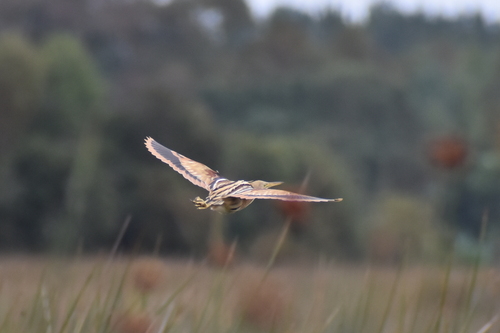
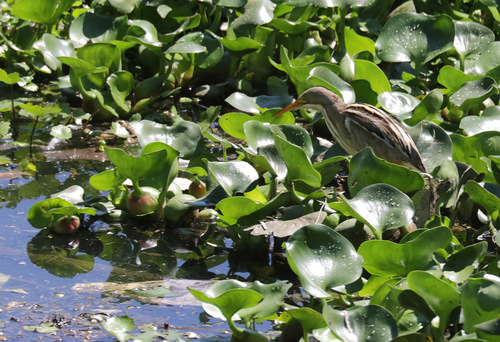
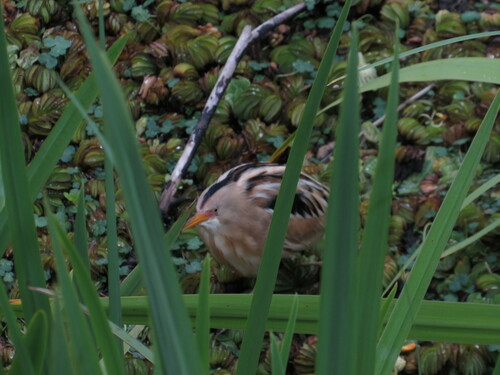
ID tip
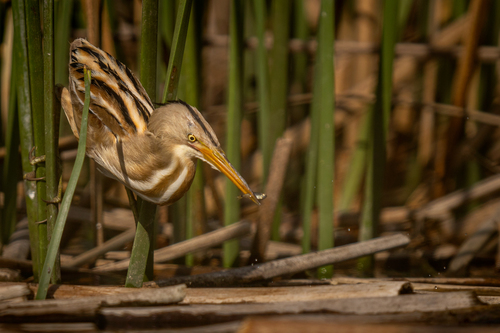
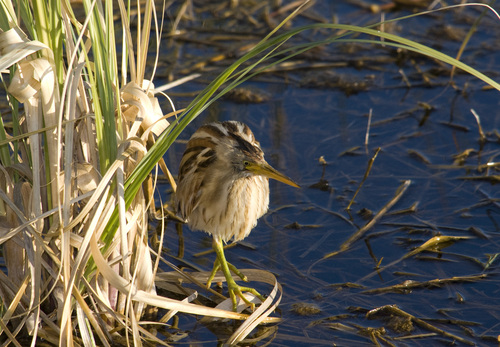
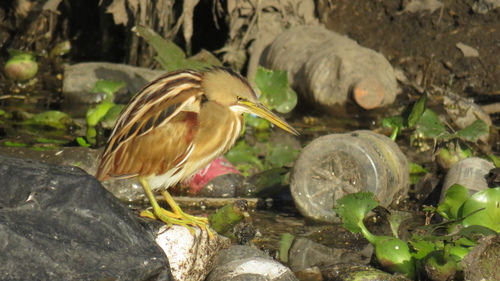
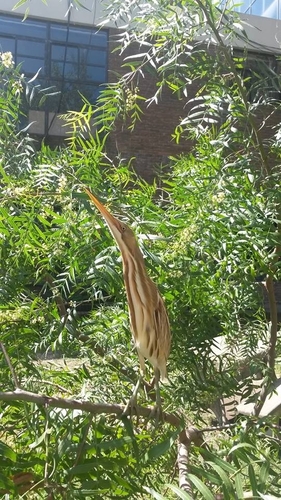
Stripe-backed bitterns are very small, averaging from 28 to 35 cm in length. Their pale brown back is ornamented with both black and yellowish-beige streaks, the latter also running along their broad wings. The colour patterns on their back complements the ones on their wings as to suppress obvious contrast between the two. Black stripes continue their way on the darker brown crown, while the underbelly is lighter brown and striped with white. As for the beak, the colour can differ from pale green to orange. Voice: Sounds have been elaborately described and are sometimes the best way to determine the presence of stripe-backed bitterns, emitting calls through distinct, low-pitched ooks, or through gargling. Territorial or warning vocalizations consist of four low-pitched short "huu" or "ook" notes, followed by a second type of vocalization; a faster and higher-pitched "g'u'u'u'a'a" gargle.
Text from Wikipedia, licensed CC BY-SA 4.0.
About the Stripe-backed Bittern
The stripe-backed bittern is a South American bird species belonging to the family Ardeidae. It was formerly placed in the genus Ixobrychus. Commonly found near freshwater swamps, marshes, lake shores and streams, stripe-backed bitterns are distributed in two disjunct populations in the north and south of the continent, spanning both sides of the Andes. Although increasingly researched worldwide, many details of its life history life are lacking, especially compared to other species in its sister clade like the least bittern.
Text adapted from Wikipedia, licensed CC BY-SA 4.0.
Easily confused with
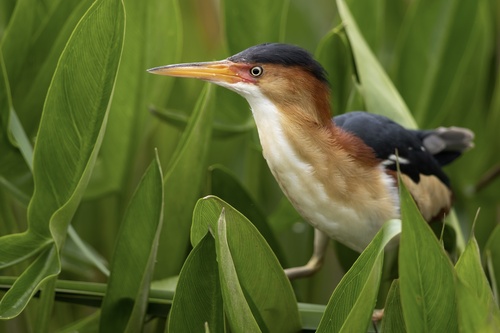 Least BitternBotaurus exilisThe least bittern is one of the smallest herons in the world, with perhaps only the dwarf bittern and the black-backed bittern averaging smaller in length.
 Black BitternBotaurus flavicollisIt is a medium sized bittern at 54–66 cm (21–26 in) in length.
 Cinnamon BitternBotaurus cinnamomeusIt is a small bittern at 38 cm (15 in) length.
Learn the Stripe-backed Bittern in the BeakBrain App
Photo and call practice. Coming soon to iPhone and Android.
Play today's Daily BirdEvery photo and recording on this page is credited to its author under the licence shown. Spotted a problem with this page, or have a better photo? Contribute.