Learn what every symbol on the card means.Full credits and sources at beakbrain.com/symbols
 ForestCavity nestMedium · 66 g

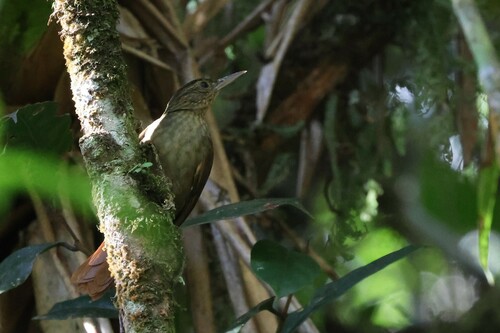
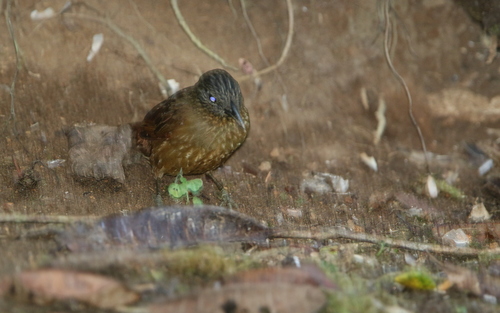
What the Streak-capped Treehunter sounds like


ID tip
The streak-capped treehunter is 21 to 23 cm (8.3 to 9.1 in) long and weighs 61 to 65 g (2.2 to 2.3 oz). It is one of the larger members of its genus and has the least amount of streaking. The sexes have the same plumage. Adults of the nominate subspecies T. v. virgaticeps have a mostly blackish-brown face with buff streaks and a tawny-buff malar area. Their lores are grizzled blackish brown and grayish buff. Their crown is blackish brown with dull buff spots on the forehead that become streaks on the crown itself. They have an indistinct dark brown collar with faint buff streaks. Voice: The streak-capped treehunter's song is "a short and evenly pitched series of emphatic and well-enunciated notes, 'chup, cheyp-cheyp-cheyp-cheyp-cheyp' ". Its call is "a fast, sharp 'ch-di-dit', 'chi-dik' or 'ju-dut', repeated at intervals of several seconds". It also makes "a nasal 'jwick' " alarm call.
Text from Wikipedia, licensed CC BY-SA 4.0.
When to see the Streak-capped Treehunter
One bar for each month, and every month is filled: this bird is recorded here in all twelve. The wide bar is February, the month with the most records.
Where to see the Streak-capped Treehunter
The map shades 3 countries with regular records. Everything unshaded has no records. Countries are listed below the map.
About the Streak-capped Treehunter
The streak-capped treehunter is a species of bird in the Furnariinae subfamily of the ovenbird family Furnariidae. It is found in Colombia, Ecuador, and Venezuela.
Text adapted from Wikipedia, licensed CC BY-SA 4.0.
Easily confused with
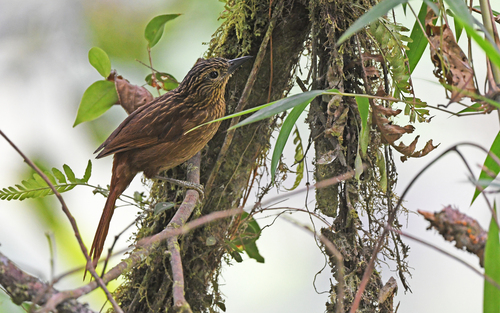 Striped TreehunterThripadectes holostictusThe striped treehunter is 20 to 21 cm (7.9 to 8.3 in) long and weighs 38 to 49 g (1.3 to 1.7 oz).
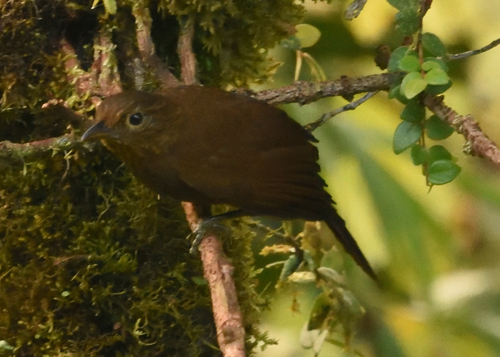 Uniform TreehunterThripadectes ignobilisThe uniform treehunter is 19 to 20 cm (7.5 to 7.9 in) long and weighs between 48 and 51 g (1.7 and 1.8 oz).
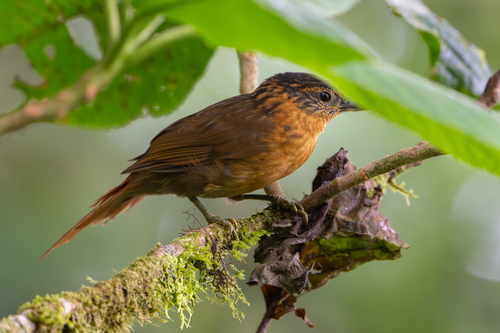 Streak-breasted TreehunterThripadectes rufobrunneusThe streak-breasted treehunter is 20 to 22 cm (7.9 to 8.7 in) long and weighs 48 to 54 g (1.7 to 1.9 oz).
Side by side: Streak-capped Treehunter vs Striped Treehunter · Streak-capped Treehunter vs Uniform Treehunter · Streak-breasted Treehunter vs Streak-capped Treehunter
Learn the Streak-capped Treehunter in the BeakBrain App
Photo and call practice. Coming soon to iPhone and Android.
Play today's Daily BirdEvery photo and recording on this page is credited to its author under the licence shown. Spotted a problem with this page, or have a better photo? Contribute.