Learn what every symbol on the card means.Full credits and sources at beakbrain.com/symbols
 WetlandPlatform nestHuge · 3.1 kg



ID tip
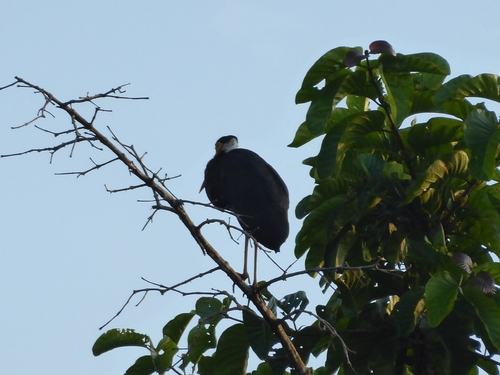
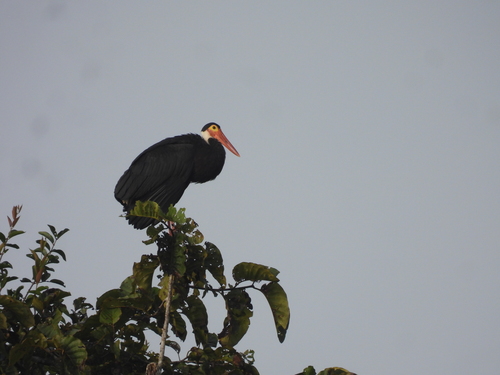
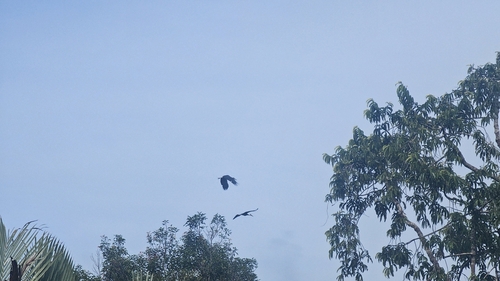
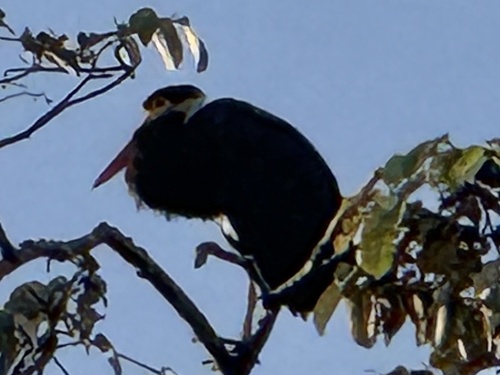
This medium-sized stork stands at 75–91 cm tall and most of the plumage is black. The undertail coverts and the back of neck are white with a black cap. It has orange facial skin with a yellow ring surrounding the eye, a red iris, and a pinkish-red bill. On some but not all male individuals, the culmen of the bill is slightly concave with a basal knob. The legs and feet of adults are dull red, but usually appear paler because they are often covered with the birds' excreta. The bill and other soft body parts darken in the breeding season.
Text from Wikipedia, licensed CC BY-SA 4.0.
When to see the Storm's Stork
One bar for each month. Filled bars are the 10 months with records; pale bars are months with none. The wide bar is March, the month with the most records.
Where to see the Storm's Stork
The map shades 2 countries with regular records, and 1 more in a lighter tone where the bird turns up only as a stray. Everything unshaded has no records. Countries are listed below the map.
Recorded as a rare visitor in Myanmar (Burma).
About the Storm's Stork
Storm's stork is a medium-sized stork species that occurs primarily in lowland tropical forests of Malaysia, Indonesia and southern Thailand. It is considered to be the rarest of all storks, and is estimated to number at most 1,750 wild individuals across its geographic range. The population has long been in decline and the primary cause is widely considered to be deforestation of its native habitat.
Text adapted from Wikipedia, licensed CC BY-SA 4.0.
Easily confused with
 Oriental StorkCiconia boycianaIt is typically larger than the white stork, at 100–129 cm (39.5–51 in) long, 110–150 cm (43–59 in) tall, a weight of 2.8–5.9 kg (6.2–13.0 lb) and a wingspan of 2.22 m (7.3 ft).
 Abdim's StorkCiconia abdimiiCiconia abdimii is a black stork with grey legs, red knees and feet, grey bill and white underparts.
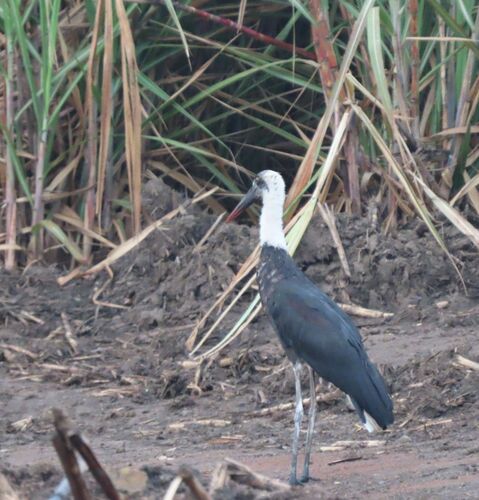 African Woolly-necked StorkCiconia microscelisThe African woolly-necked stork is a medium-sized stork at 75–92 cm tall.
Learn the Storm's Stork in the BeakBrain App
Photo and call practice. Coming soon to iPhone and Android.
Play today's Daily BirdEvery photo and recording on this page is credited to its author under the licence shown. Spotted a problem with this page, or have a better photo? Contribute.