Learn what every symbol on the card means.Full credits and sources at beakbrain.com/symbols
 ForestCavity nestMedium · 93 g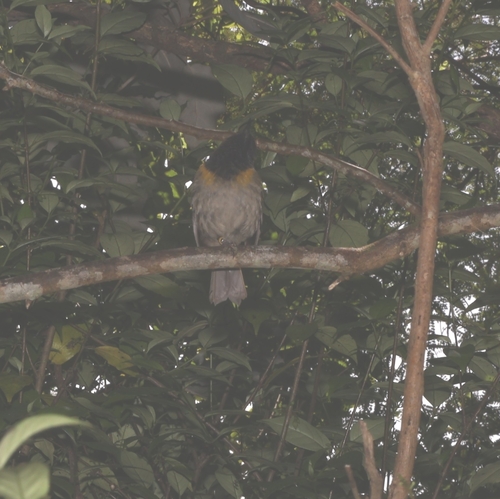
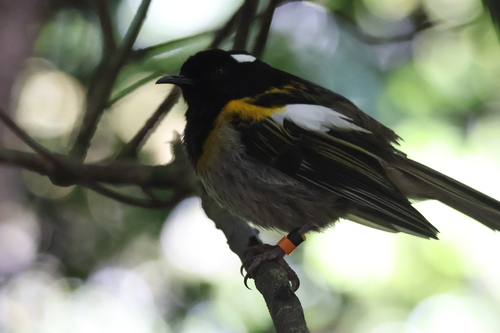
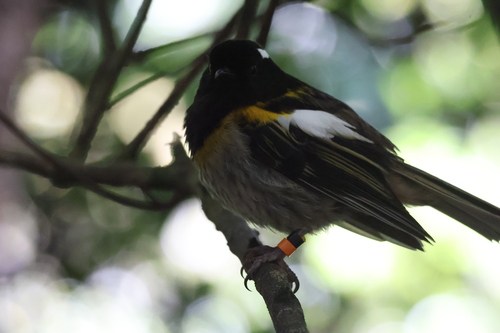
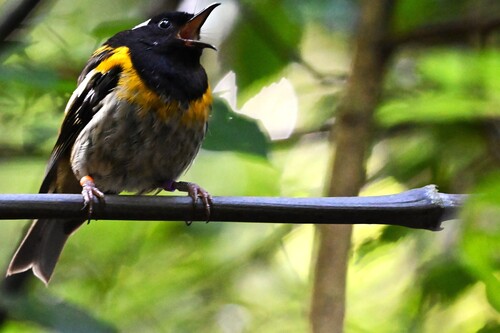


ID tip
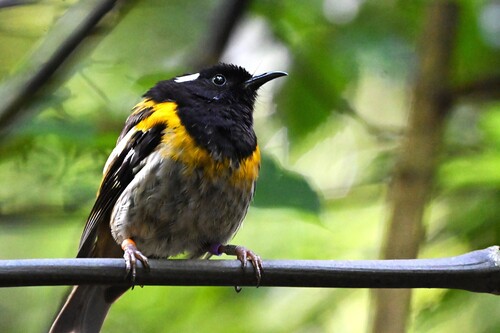
The stitchbird is a small honeyeater-like bird. Males have a dark velvety cap and short white ear-tufts, which can be raised somewhat away from the head. A yellow band across the chest separates the black head from the rest of the body, which is grey. Females and juveniles are duller than males, lacking the black head and yellow chest band. The bill is rather thin and somewhat curved, and the tongue is long with a brush at the end for collecting nectar. Thin whiskers project out and slightly forward from the base of the bill. Stitchbirds are very active and call frequently.
Text from Wikipedia, licensed CC BY-SA 4.0.
When to see the Stitchbird
One bar for each month. Filled bars are the 11 months with records; pale bars are months with none. The wide bar is November, the month with the most records.
Where to see the Stitchbird
The map shades 1 country with regular records. Everything unshaded has no records. Countries are listed below the map.
About the Stitchbird
The stitchbird or hihi is a honeyeater-like bird endemic to the North Island and adjacent offshore islands of New Zealand. Its evolutionary relationships have long puzzled ornithologists, but it is now classed as the only member of its own family, the Notiomystidae. It is rare, being extirpated everywhere except Little Barrier Island, but has been reintroduced to two other island sanctuaries and four locations on the North Island mainland. Current population estimations for mature individuals in the wild are 2,500–3,400.
Text adapted from Wikipedia, licensed CC BY-SA 4.0.
Learn the Stitchbird in the BeakBrain App
Photo and call practice. Coming soon to iPhone and Android.
Play today's Daily BirdEvery photo and recording on this page is credited to its author under the licence shown. Spotted a problem with this page, or have a better photo? Contribute.