Learn what every symbol on the card means.Full credits and sources at beakbrain.com/symbols
 MarinePlatform nestLarge · 807 g



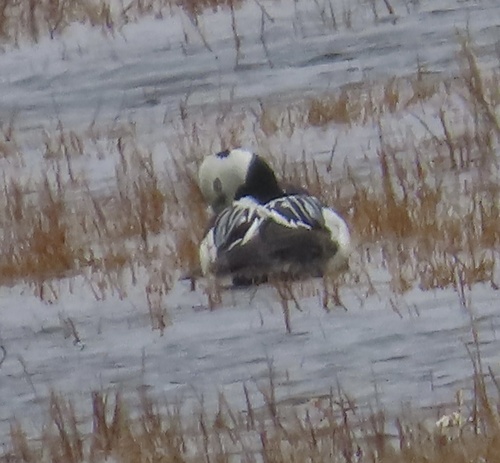





ID tip
Steller's eider is the smallest of the four eiders, with both females and males weighing 860 g (30 oz) on average. They have a compact body with a relatively large head with a flat crown and an angled nape, and a long, thick bill; the tail is relatively longer than other eiders. The males assume their breeding plumage from early winter to midsummer with a black cap, chin, collar, eye-ring, and rump, with a white head and shoulders, light green patches behind the head and in front of the eye, and the cinnamon breast and shoulders marked with a prominent black spot.
Text from Wikipedia, licensed CC BY-SA 4.0.
When to see the Steller's Eider
One bar for each month. Filled bars are the 8 months with records; pale bars are months with none. The wide bar is June, the month with the most records.
Where to see the Steller's Eider
The map shades 12 countries with regular records, and 5 more in a lighter tone where the bird turns up only as a stray. Everything unshaded has no records. Countries are listed below the map.
Recorded as a rare visitor in United Kingdom, Germany, Canada, Japan, Netherlands.
About the Steller's Eider
Steller's eider is a migratory Arctic sea duck that breeds along the coastlines of Russia and Alaska, as well as in the Baltic Sea. It is the smallest, and fastest flying of the duck species known as eiders; it is closely related to the other species of eider in the genus Somateria, but sufficiently distinct to be given separate recognition as the only member of the genus Polysticta.
Text adapted from Wikipedia, licensed CC BY-SA 4.0.
Easily confused with
 Andean GooseChloephaga melanopteraThe Andean goose is 70 to 76 cm (28 to 30 in) long and weighs 2.73 and 3.64 kg (6.0 and 8.0 lb).
 Freckled DuckStictonetta naevosaThe freckled duck has a distinctive appearance.
 Ringed TealCallonetta leucophrysThe ringed teal is 35–38 cm (14–15 in) long, with a 70 cm (28 in) wingspan, and a weight of 190–360 g (6.7–12.7 oz).
Side by side: Andean Goose vs Steller's Eider · Ringed Teal vs Steller's Eider · Freckled Duck vs Steller's Eider
Learn the Steller's Eider in the BeakBrain App
Photo and call practice. Coming soon to iPhone and Android.
Play today's Daily BirdEvery photo and recording on this page is credited to its author under the licence shown. Spotted a problem with this page, or have a better photo? Contribute.