Learn what every symbol on the card means.Full credits and sources at beakbrain.com/symbols
 ForestDomed nestLarge · 336 g
What the Starred Wood Quail sounds like

ID tip
The starred wood quail is between about 24 and 28 cm (9.4 and 11.0 in) long, males being slightly larger than females. The bill is blackish, the irises brown and the legs grey, and the long feathers on the back of the head form a pronounced crest, reddish-brown in the male and brownish-black in the female. Other than this, the sexes are very similar in appearance; the front of the crown is dark brown and the rest of the head, neck, throat and mantle is grey.
Text from Wikipedia, licensed CC BY-SA 4.0.
When to see the Starred Wood Quail
One bar for each month. Filled bars are the 8 months with records; pale bars are months with none. The wide bar is October, the month with the most records.
Where to see the Starred Wood Quail
The map shades 4 countries with regular records, and 1 more in a lighter tone where the bird turns up only as a stray. Everything unshaded has no records. Countries are listed below the map.
Recorded as a rare visitor in Colombia.
About the Starred Wood Quail
The starred wood quail is a species of bird in the family Odontophoridae. It is found in subtropical or tropical moist lowland forests of Bolivia, Brazil, Ecuador, and Peru.
Text adapted from Wikipedia, licensed CC BY-SA 4.0.
Easily confused with
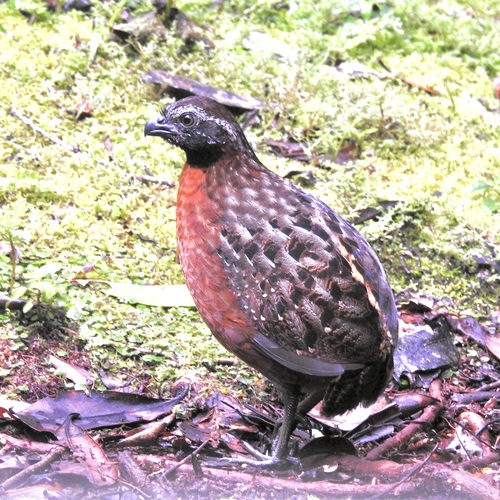 Rufous-breasted Wood QuailOdontophorus speciosusThe rufous-breasted wood quail is a species of bird in the family Odontophoridae.
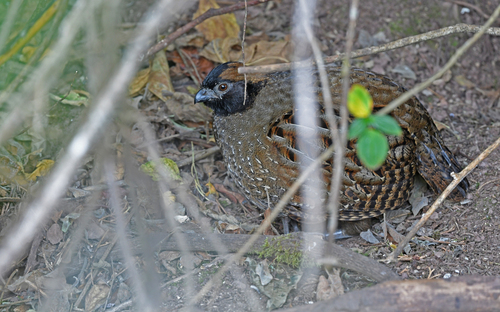 Black-fronted Wood QuailOdontophorus atrifronsThe black-fronted wood quail is 24 to 30 cm (9.4 to 11.8 in) long.
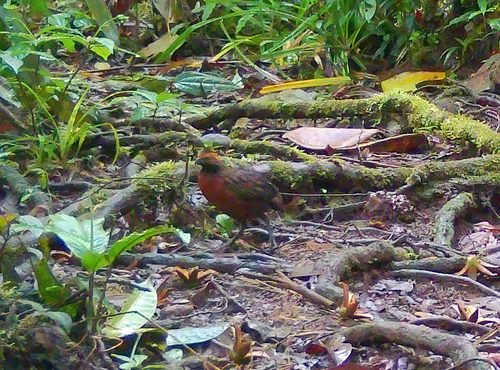 Rufous-fronted Wood QuailOdontophorus erythropsThe rufous-fronted wood quail is 23 to 28 cm (9.1 to 11.0 in) long.
Learn the Starred Wood Quail in the BeakBrain App
Photo and call practice. Coming soon to iPhone and Android.
Play today's Daily BirdEvery photo and recording on this page is credited to its author under the licence shown. Spotted a problem with this page, or have a better photo? Contribute.