Learn what every symbol on the card means.Full credits and sources at beakbrain.com/symbols
 WoodlandScrapeMedium · 221 g


ID tip
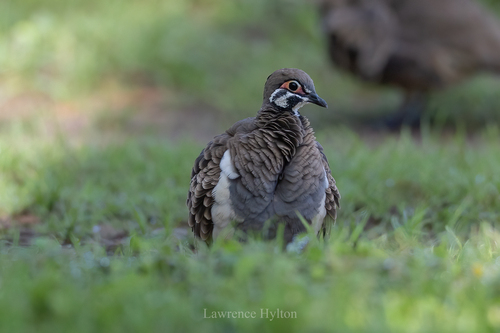
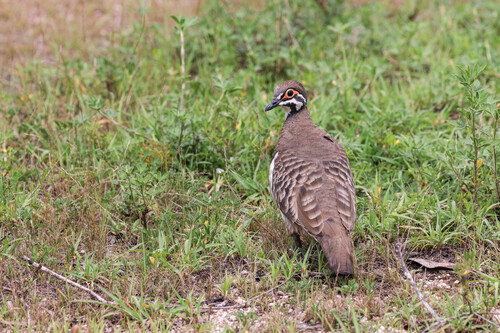
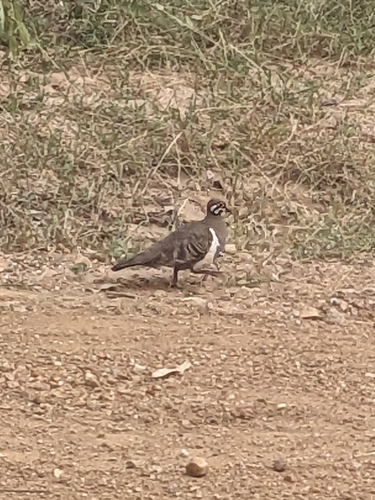
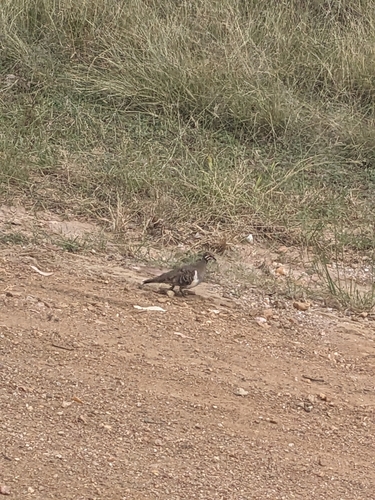
It measures approximately 30 cm in length, weighing between 190 g and 250 g. Adults are mainly a grey-brown, with distinctive black and white facial markings and a white stripe up each of its sides. Blue-grey skin around the eyes, dark brown and patches of iridescent green or violet on the upper wings, blue-grey on the lower breast and belly, and a white lower region. The sexes are similar in appearance. Juveniles can be distinguished by their duller colouring, less distinctive facial stripes, and paler facial skin.
Text from Wikipedia, licensed CC BY-SA 4.0.
When to see the Squatter Pigeon
One bar for each month, and every month is filled: this bird is recorded here in all twelve. The wide bar is October, the month with the most records.
Where to see the Squatter Pigeon
The map shades 1 country with regular records. Everything unshaded has no records. Countries are listed below the map.
About the Squatter Pigeon
The squatter pigeon is a species of bird in the family Columbidae. It is endemic to northeastern Australia. According to Australia's then Department of the Environment and Energy, the nominate subspecies, southern squatter pigeon is listed as vulnerable. It lives in arid and semi-arid areas, including grasslands and dry sclerophyll forests, and nest in shallow depressions in the ground. About 95% of the diet of these birds consists of seeds, as they are known for foraging on the ground.
Text adapted from Wikipedia, licensed CC BY-SA 4.0.
Easily confused with
 Partridge PigeonGeophaps smithiiThe partridge pigeon is a species of bird in the family Columbidae.
 Spinifex PigeonGeophaps plumiferaThe Spinifex pigeon is a small and compact pigeon, which weighs 80–110 g (2.8–3.9 oz), has a mean body length of 200–235 mm (7.9–9.3 in), and has a wingspan of 300–350 mm (12–14 in).
Side by side: Spinifex Pigeon vs Squatter Pigeon
Learn the Squatter Pigeon in the BeakBrain App
Photo and call practice. Coming soon to iPhone and Android.
Play today's Daily BirdEvery photo and recording on this page is credited to its author under the licence shown. Spotted a problem with this page, or have a better photo? Contribute.