Learn what every symbol on the card means.Full credits and sources at beakbrain.com/symbols
 ForestCavity nestLarge · 586 g


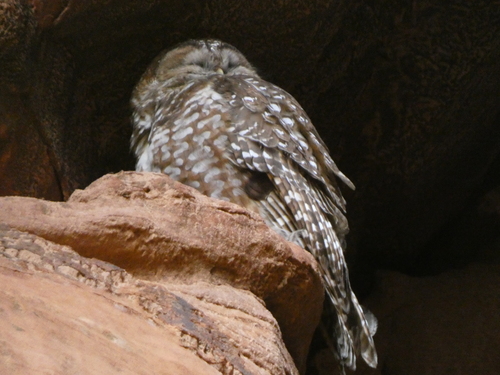


ID tip
The spotted owl has an average length of 43 cm (17 in), wingspan of 114 cm (45 in), and weight of 600 g (1.3 lb). Its eggs are a little over 50 mm (2.0 in) long, and are white and smooth with a slightly grainy texture. The spotted owl is similar in appearance to the barred owl, but has cross-shaped markings on the underparts, whereas the barred owl is alternately barred on the breast and streaked on the belly. Barred owls are larger and grayer than spotted owls. In recent years, the California and northern subspecies of spotted owl have been displaced by barred owls (S.
Text from Wikipedia, licensed CC BY-SA 4.0.
When to see the Spotted Owl
One bar for each month. Filled bars are the 7 months with records; pale bars are months with none. The wide bar is July, the month with the most records.
Where to see the Spotted Owl
The map shades 1 country with regular records, and 1 more in a lighter tone where the bird turns up only as a stray. Everything unshaded has no records. Countries are listed below the map.
Recorded as a rare visitor in United States.
About the Spotted Owl
The spotted owl is a species of true owl. It is a resident species of old-growth forests in western North America, where it nests in tree hollows, old bird of prey nests, or rock crevices. Nests can be between 12 and 60 metres from the ground, and usually contain two eggs. It is a nocturnal owl which feeds on small mammals and birds. Three subspecies are recognized, ranging in distribution from British Columbia to Mexico. The spotted owl is under pressure from habitat destruction throughout its range, and is currently classified as a near-threatened species.
Text adapted from Wikipedia, licensed CC BY-SA 4.0.
Easily confused with
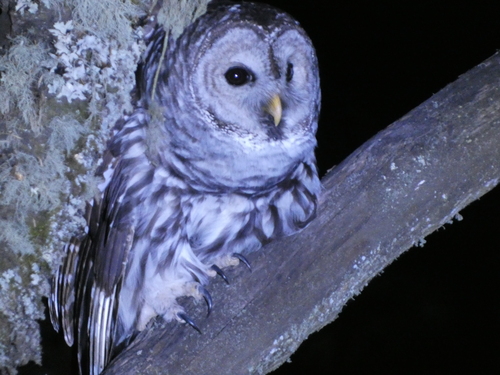 Cinereous OwlStrix sartoriiVery few specimens of cinereous owl have been measured.
 Desert OwlStrix hadoramiThe desert owl or desert tawny owl, formerly known as Hume's owl, is a species of owl.
 Omani OwlStrix butleriThe Omani owl has a bi-coloured pale and dark grey face with orange eyes, dark greyish brown upperparts, pale underparts with long, narrow vertical dark streaks, relatively long legs, banded wings, and a banded tail.
Learn the Spotted Owl in the BeakBrain App
Photo and call practice. Coming soon to iPhone and Android.
Play today's Daily BirdEvery photo and recording on this page is credited to its author under the licence shown. Spotted a problem with this page, or have a better photo? Contribute.