Learn what every symbol on the card means.Full credits and sources at beakbrain.com/symbols
 ForestCavity nestSmall · 31 g
ID tip
Spix's woodcreeper is a medium-sized member of its genus, with a longish, slim, slightly decurved bill. The species is 18.5 to 21 cm (7.3 to 8.3 in) long and weighs 27 to 36 g (0.95 to 1.27 oz). The sexes have the same plumage. Adults have a dusky brown face with narrow buff streaks and a pale supercilium and eyering. Their crown and nape are blackish brown with small buff teardrop spots that are streakier and blackish-edged on the nape. Their back and wing coverts are olive-brown, with buff teardrop spots with blackish edges on the back. Their wing coverts have buffy stripes or spots. Voice: The song of Spix's woodcreeper is a "very high, very fast trill, descending at beginning, level at end, last note higher". It has been put into words as "twe-tee-ti-ti-ti-…-ti-ti-it, wheu". Its calls are described as similar to those of the elegant woodcreeper, "sharp 'chip' notes followed by a whine", also described as "3-noted 'tjictjicwuuuw' ".
Text from Wikipedia, licensed CC BY-SA 4.0.
When to see the Spix's Woodcreeper
One bar for each month. Filled bars are the 9 months with records; pale bars are months with none. The wide bar is August, the month with the most records.
Where to see the Spix's Woodcreeper
The map shades 2 countries with regular records, and 2 more in a lighter tone where the bird turns up only as a stray. Everything unshaded has no records. Countries are listed below the map.
About the Spix's Woodcreeper
Spix's woodcreeper is a species of bird in the subfamily Dendrocolaptinae of the ovenbird family Furnariidae. It is endemic to Brazil.
Text adapted from Wikipedia, licensed CC BY-SA 4.0.
Easily confused with
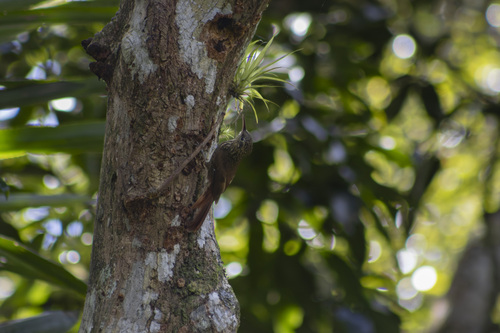 Ceara WoodcreeperXiphorhynchus atlanticusThe Ceara woodcreeper is a small, slim member of its genus, with a disproportionatly large head and a longish, slim, slightly decurved bill.
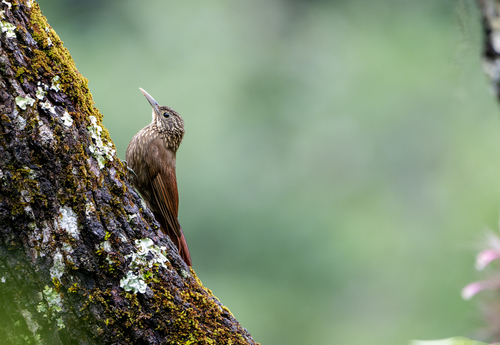 Ocellated WoodcreeperXiphorhynchus ocellatusThe ocellated woodcreeper is 20 to 24.5 cm (7.9 to 9.6 in) long and weighs 24 to 42 g (0.85 to 1.5 oz).
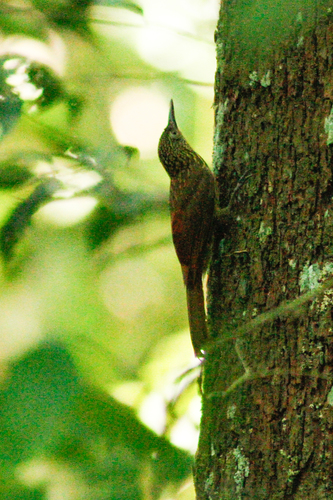 Chestnut-rumped WoodcreeperXiphorhynchus pardalotusThe chestnut-rumped woodcreeper is a medium-sized member of its genus, with a longish, slim, slightly decurved bill.
Learn the Spix's Woodcreeper in the BeakBrain App
Photo and call practice. Coming soon to iPhone and Android.
Play today's Daily BirdEvery photo and recording on this page is credited to its author under the licence shown. Spotted a problem with this page, or have a better photo? Contribute.