Learn what every symbol on the card means.Full credits and sources at beakbrain.com/symbols
 GrasslandCavity nestMedium · 188 g




ID tip
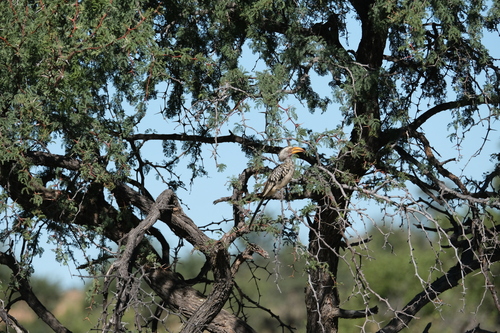
It is a medium-sized bird, 48–60 cm (19–24 in) in length, 132–242 g (0.29–0.53 lb) in weight and is characterized by a long yellow and down-curved beak. This beak is huge in comparison to its body and can account for up 1/6th of the entire body length. Male beaks are on average 90 mm long while female beaks are an average of 74 mm. Males are generally bigger than females but there is overlap between the sexes. The size difference of the beak is a fairly reliable way of differentiating sex in wild hornbills. Voice: Southern yellow-billed hornbills have a piercing cry. However it has a wide variety of sounds it can make such as, whistling, grunting and caqueting. They will use their loud calls to either delimit their territory or for long-distance communication. Like other Tockus, they will often accompany their calls with conspicuous physical displays.
Text from Wikipedia, licensed CC BY-SA 4.0.
When to see the Southern Yellow-billed Hornbill
One bar for each month, and every month is filled: this bird is recorded here in all twelve. The wide bar is September, the month with the most records.
Where to see the Southern Yellow-billed Hornbill
The map shades 9 countries with regular records. Everything unshaded has no records. Countries are listed below the map.
About the Southern Yellow-billed Hornbill
The southern yellow-billed hornbill is a hornbill found in southern Africa. Yellow-billed hornbills feed mainly on the ground, where they forage for seeds, small insects, spiders and scorpions. This hornbill species is a common and widespread resident of dry thornveldt and broad-leafed woodlands. They can often be seen along roads and water courses.
Text adapted from Wikipedia, licensed CC BY-SA 4.0.
Easily confused with
 Northern Red-billed HornbillTockus erythrorhynchusThe northern red-billed hornbill is a species of hornbill in the family Bucerotidae.
 Southern Red-billed HornbillTockus rufirostrisThe sexes are similar, but males are larger and heavier.
 Von der Decken's HornbillTockus deckeniThis species is a small hornbill with blackish upperparts and mainly whitish underparts and head.
Side by side: Southern Red-billed Hornbill vs Southern Yellow-billed Hornbill · Southern Yellow-billed Hornbill vs Von der Decken's Hornbill
Learn the Southern Yellow-billed Hornbill in the BeakBrain App
Photo and call practice. Coming soon to iPhone and Android.
Play today's Daily BirdEvery photo and recording on this page is credited to its author under the licence shown. Spotted a problem with this page, or have a better photo? Contribute.