Learn what every symbol on the card means.Full credits and sources at beakbrain.com/symbols
 GrasslandCavity nestHuge · 3.7 kg


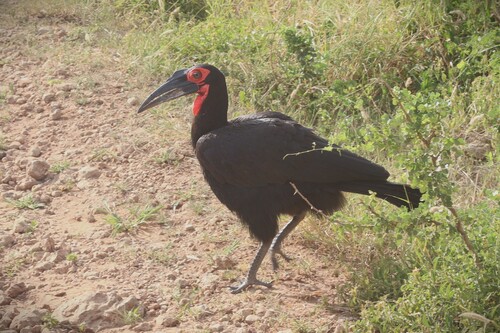
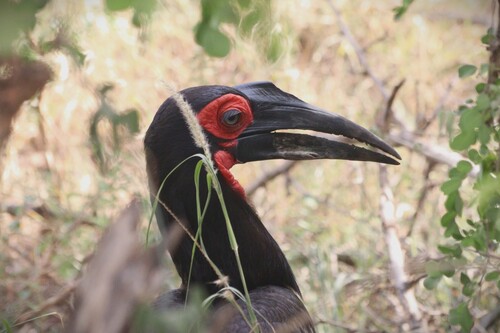
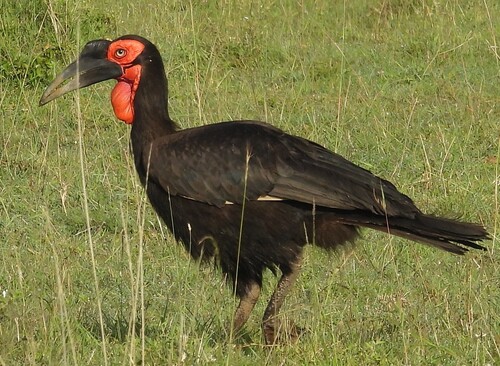
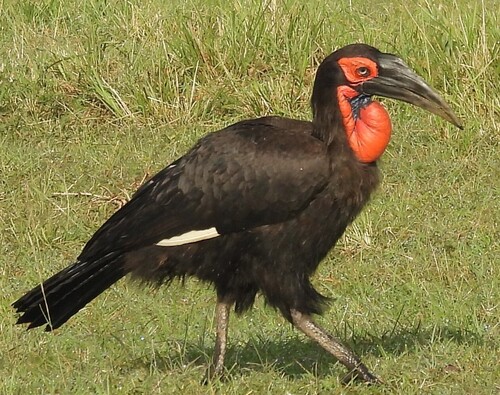
ID tip
This is a large bird, at 90 to 129 cm (2 ft 11 in to 4 ft 3 in) long. Females weigh 2.2 to 4.6 kilograms (4.9 to 10.1 lb), while the larger males weigh 3.5 to 6.2 kilograms (7.7 to 13.7 lb). The average weight of eight females was 3.34 kg (7.4 lb) whilst that of eight males was 4.2 kg (9.3 lb); thus they average around 35% percent heavier than any Asian hornbill species. Wingspan is from 1.2 to 1.8 m (3 ft 11 in to 5 ft 11 in). The wing chord is 49.5 to 61.8 cm (19.5 to 24.3 in), the tail from 29 to 36 cm (11 to 14 in), the tarsus from 13 to 15.5 cm (5.1 to 6.1 in) and the culmen from 16.
Text from Wikipedia, licensed CC BY-SA 4.0.
When to see the Southern Ground Hornbill
One bar for each month, and every month is filled: this bird is recorded here in all twelve. The wide bar is November, the month with the most records.
Where to see the Southern Ground Hornbill
The map shades 12 countries with regular records. Everything unshaded has no records. Countries are listed below the map.
About the Southern Ground Hornbill
The southern ground hornbill is one of two species of ground hornbill, both of which are found solely within Africa, and is the largest species in the hornbill order worldwide. It can be found in the southern regions of Africa, ranging from Kenya to South Africa. Within these regions, they inhabit both woodlands and savannas. The other species of the genus Bucorvus is the Abyssinian ground hornbill, B. abyssinicus.
Text adapted from Wikipedia, licensed CC BY-SA 4.0.
Easily confused with

Side by side: Abyssinian Ground Hornbill vs Southern Ground Hornbill
Learn the Southern Ground Hornbill in the BeakBrain App
Photo and call practice. Coming soon to iPhone and Android.
Play today's Daily BirdEvery photo and recording on this page is credited to its author under the licence shown. Spotted a problem with this page, or have a better photo? Contribute.