Learn what every symbol on the card means.Full credits and sources at beakbrain.com/symbols
 MarineScrapeMedium · 188 g


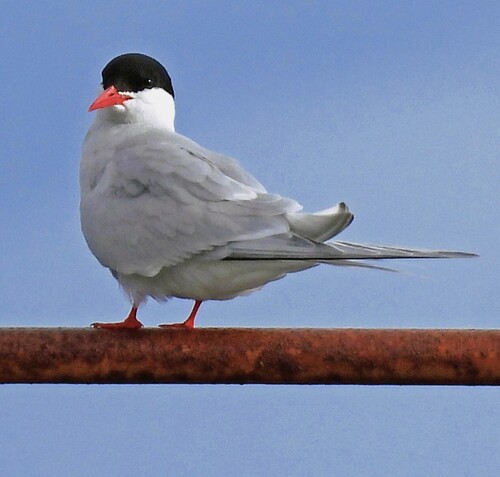
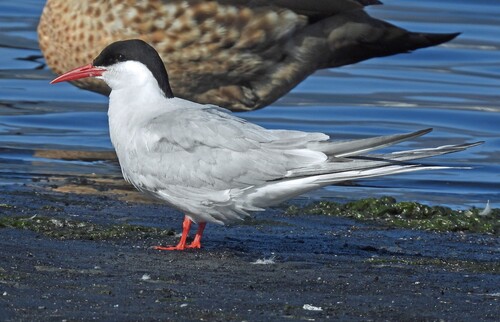



ID tip
With adult South American terns reaching a length of 40 to 44 centimetres (16 to 17 in), they are larger than either common terns (Sterna hirundo) or Arctic terns (Sterna paradisaea). Otherwise they closely resemble these species in plumage at all times of year. The beak is larger and is red in adults, and they do not have a dark-coloured bar on the carpus of the wing. The black cap extends below the eye, usually separated from it by a white crescent, and the rear edge of the cap is neatly defined.
Text from Wikipedia, licensed CC BY-SA 4.0.
When to see the South American Tern
One bar for each month. Filled bars are the 9 months with records; pale bars are months with none. The wide bar is November, the month with the most records.
Where to see the South American Tern
The map shades 7 countries with regular records. Everything unshaded has no records. Countries are listed below the map.
About the South American Tern
The South American tern is a species of tern found in coastal regions of southern South America, including the Falkland Islands, ranging north to Peru and Brazil. It is generally the most common tern in its range. The smaller, highly migratory common tern closely resembles it. The specific epithet refers to the "swallow-like" forked tail feathering.
Text adapted from Wikipedia, licensed CC BY-SA 4.0.
Easily confused with
 White-fronted TernSterna striataThe white-fronted tern is an average-sized tern; its dimensions are 35–43 cm (14–17 in) in length, with a wingspan between 79 and 82 cm (31 and 32 in); the male weighs on average 130 g (4.6 oz).
 Snowy-crowned TernSterna trudeauiThe snowy-crowned tern is 28 to 35 cm (11 to 14 in) long with a wingspan of 76 to 78 cm (30 to 31 in) and weighs 146 to 160 g (5.1 to 5.6 oz).
 Roseate TernSterna dougalliiThis is a small-medium tern, 33–36 cm (13–14 in) long with a 67–76 cm (26–30 in) wingspan, which can be confused with the common tern, Arctic tern, and the larger, but similarly plumaged, Sandwich tern.
Side by side: River Tern vs South American Tern · Roseate Tern vs South American Tern · South American Tern vs White-fronted Tern · Snowy-crowned Tern vs South American Tern
Learn the South American Tern in the BeakBrain App
Photo and call practice. Coming soon to iPhone and Android.
Play today's Daily BirdEvery photo and recording on this page is credited to its author under the licence shown. Spotted a problem with this page, or have a better photo? Contribute.