Learn what every symbol on the card means.Full credits and sources at beakbrain.com/symbols
 WetlandPlatform nestMedium · 75 g


What the Sora sounds like


ID tip
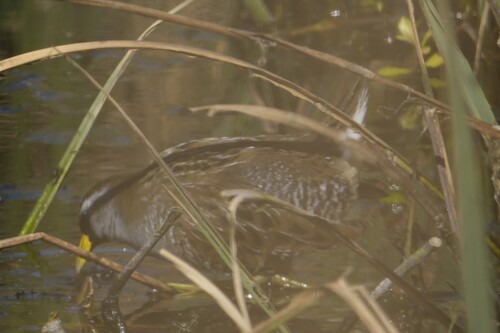
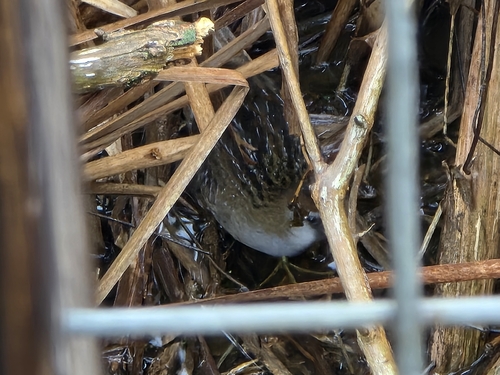
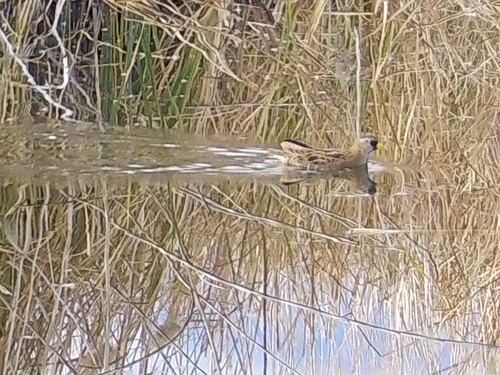
Adult soras are 19–30 cm (7.5–11.8 in) long, with dark-marked brown upperparts, a blue-grey face and underparts, and black and white barring on the flanks. They have a short thick yellow bill, with black markings on the face at the base of the bill and on the throat. Sexes are similar, but young soras lack the black facial markings and have a whitish face and buff breast. They weigh about 49–112 g (1.7–4.0 oz) and have a wingspan of 35–40 cm.
Text from Wikipedia, licensed CC BY-SA 4.0.
When to see the Sora
One bar for each month, and every month is filled: this bird is recorded here in all twelve. The wide bar is May, the month with the most records.
Where to see the Sora
The map shades 45 countries with regular records, and 5 more in a lighter tone where the bird turns up only as a stray. Everything unshaded has no records. Countries are listed below the map.
Recorded as a rare visitor in Sweden, Spain, France, Ireland, Dominica.
About the Sora
The sora, sora rail or Carolina crake is a small waterbird of the rail family Rallidae, sometimes also referred to as the sora rail or sora crake, that occurs throughout much of North America. The genus name Porzana is derived from Venetian terms for small rails, and the specific carolina refers to the Carolina Colony. The common name "Sora" is probably derived from a Native American language.
Text adapted from Wikipedia, licensed CC BY-SA 4.0.
Easily confused with
 Spotted CrakePorzana porzanaThe spotted crake is a small waterbird of the family Rallidae.
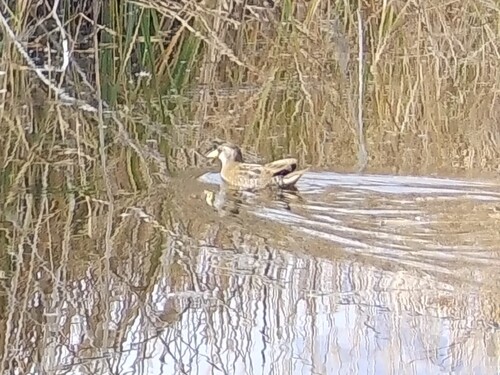
 Australian CrakePorzana flumineaThe Australian crake measures 19–23 cm (7.5–9.1 in) in length, weighs 55–70 g (1.9–2.5 oz) and has a wingspan of 27–33 cm (11–13 in).
Side by side: Australian Crake vs Sora
Learn the Sora in the BeakBrain App
Photo and call practice. Coming soon to iPhone and Android.
Play today's Daily BirdEvery photo and recording on this page is credited to its author under the licence shown. Spotted a problem with this page, or have a better photo? Contribute.