Learn what every symbol on the card means.Full credits and sources at beakbrain.com/symbols
 ForestCup nestTiny · 6 g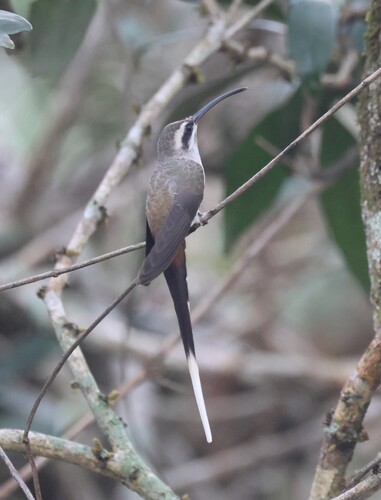


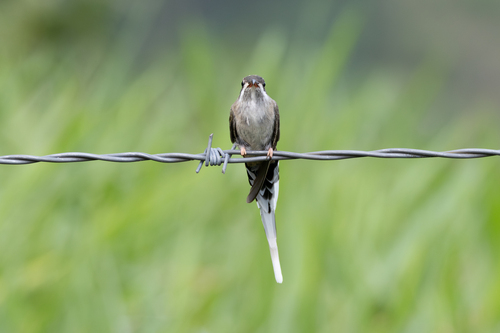
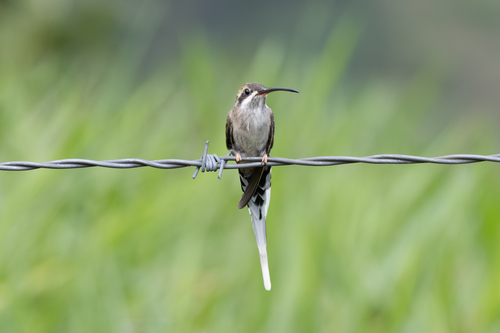


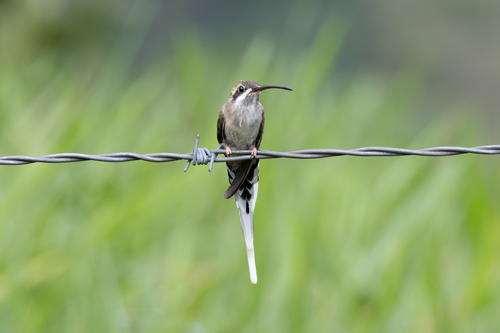
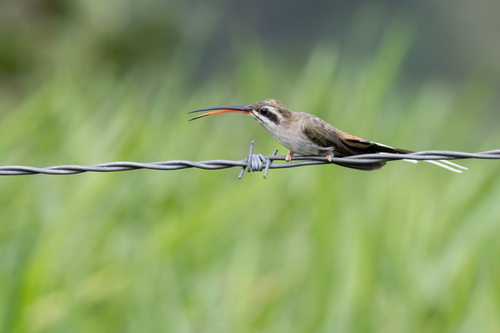
ID tip
The sooty-capped hermit is about 14 to 15 cm (5.5 to 5.9 in) long. Males weigh 4.5 to 6 g (0.16 to 0.21 oz) and females 4 to 5 g (0.14 to 0.18 oz). They are mostly grayish brown above with a rufous rump and uppertail coverts. The next-to-inner tail feathers are longer than the others and all have white tips. Their underparts are gray. The face has a black "mask" with a white supercilium and gular stripe. The subspecies differ slightly in the intensity of the breast and uppertail covert colors and the size of the gular stripe. What was once thought to be a separate species P. Voice: The sooty-capped hermit's song is "a continuously repeated phrase consisting of 2–3 high notes followed by 2–3 somewhat lower ones, e.g. 'tsee-tsee-tsee-sew-sew....tsee-tsee-tsee-sew-sew...'." The male sings from a perch at a lek while wagging its tail. It also makes a "rather monotonous 'tseet'" call.
Text from Wikipedia, licensed CC BY-SA 4.0.
When to see the Sooty-capped Hermit
One bar for each month, and every month is filled: this bird is recorded here in all twelve. The wide bar is May, the month with the most records.
Where to see the Sooty-capped Hermit
The map shades 6 countries with regular records. Everything unshaded has no records. Countries are listed below the map.
About the Sooty-capped Hermit
The sooty-capped hermit is a species of bird in the family Trochilidae, the hummingbirds. It is found in Brazil, Colombia, French Guiana, Guyana, Suriname, and Venezuela.
Text adapted from Wikipedia, licensed CC BY-SA 4.0.
Easily confused with
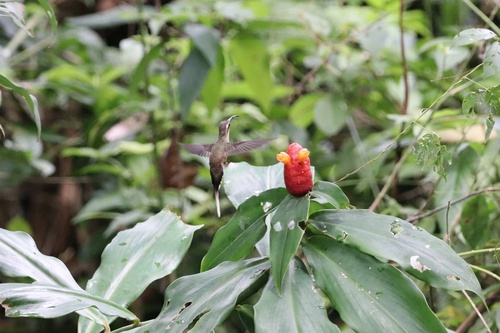 Long-tailed HermitPhaethornis superciliosusThe adult long-tailed hermit is mainly dull brownish green above with a buff-tinged rump.
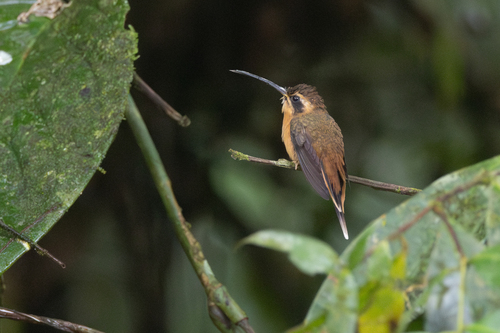 Grey-chinned HermitPhaethornis griseogularisThe nominate P. g. griseogularis and P. g. zonura subspecies of grey-chinned hermit are 8 to 10 cm (3.1 to 3.9 in) long; males weigh 1.8 to 2.5 g (0.06 to 0.09 oz) and females 1.9 to 3 g (0.07 to 0.11 oz).
 Straight-billed HermitPhaethornis bourcieriThe straight-billed hermit is 12 to 14 cm (4.7 to 5.5 in) long and weighs 3.5 to 5 g (0.12 to 0.18 oz).
Side by side: Great-billed Hermit vs Sooty-capped Hermit · Grey-chinned Hermit vs Sooty-capped Hermit · Long-tailed Hermit vs Sooty-capped Hermit · Sooty-capped Hermit vs Straight-billed Hermit
Learn the Sooty-capped Hermit in the BeakBrain App
Photo and call practice. Coming soon to iPhone and Android.
Play today's Daily BirdEvery photo and recording on this page is credited to its author under the licence shown. Spotted a problem with this page, or have a better photo? Contribute.