Learn what every symbol on the card means.Full credits and sources at beakbrain.com/symbols
 ShrublandCavity nestSmall · 28 g


What the Social Flycatcher sounds like


ID tip
The social flycatcher is 16 to 18.5 cm (6.3 to 7.3 in) long and weighs 24 to 27 g (0.85 to 0.95 oz). The sexes have the same plumage, though females average slightly smaller than males. Adults of the nominate subspecies M. s. similis have a dark gray to brownish gray head with a mostly hidden bright red to orangish red patch in the center of the crown. They have a wide white supercilium that begins on the forehead and extends far past the eye. Voice: What is thought to be the social flycatcher's dawn song is a "shrill note repeated several times, sometimes followed by longer and continuously repeated series, seeu, seeu, see-u-chú, sree, sree, sree si-si-chuhr, or shorter but still repeated chirrrr". It also makes "a shrill and piercing seeá, tcheiit or see-yh!
Text from Wikipedia, licensed CC BY-SA 4.0.
When to see the Social Flycatcher
One bar for each month, and every month is filled: this bird is recorded here in all twelve. The wide bar is March, the month with the most records.
Where to see the Social Flycatcher
The map shades 17 countries with regular records, and 1 more in a lighter tone where the bird turns up only as a stray. Everything unshaded has no records. Countries are listed below the map.
Recorded as a rare visitor in United States.
About the Social Flycatcher
The social flycatcher is a passerine bird from the Americas, a member of the large tyrant flycatcher family Tyrannidae. It is found in Mexico, every Central American country, and every mainland South American country except Chile, Guyana, Suriname, and Uruguay. It has also occurred as a vagrant in the United States.
Text adapted from Wikipedia, licensed CC BY-SA 4.0.
Easily confused with
 Rusty-margined FlycatcherMyiozetetes cayanensisThe rusty-margined flycatcher is 16.5 to 18 cm (6.5 to 7.1 in) long and weighs 22 to 29.5 g (0.78 to 1.0 oz).
 Grey-capped FlycatcherMyiozetetes granadensisThe grey-capped flycatcher is 16 to 18 cm (6.3 to 7.1 in) long and weighs 28 to 30 g (0.99 to 1.1 oz).
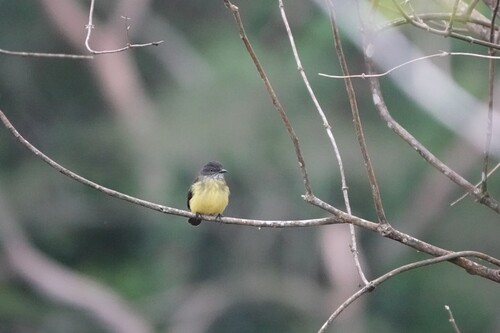 Dusky-chested FlycatcherMyiozetetes luteiventrisThe dusky-chested flycatcher is the smallest member of genus Myiozetetes.
Side by side: Rusty-margined Flycatcher vs Social Flycatcher · Grey-capped Flycatcher vs Social Flycatcher · Dusky-chested Flycatcher vs Social Flycatcher
Learn the Social Flycatcher in the BeakBrain App
Photo and call practice. Coming soon to iPhone and Android.
Play today's Daily BirdEvery photo and recording on this page is credited to its author under the licence shown. Spotted a problem with this page, or have a better photo? Contribute.