Learn what every symbol on the card means.Full credits and sources at beakbrain.com/symbols
 ForestCup nestTiny · 8 g
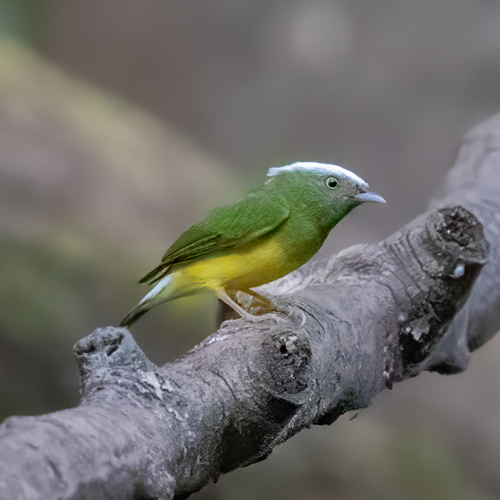
ID tip
The snow-capped manakin is 8.5 to 9.2 cm (3.3 to 3.6 in) long and weighs about 8 to 10 g (0.28 to 0.35 oz). The species is sexually dimorphic and females are larger than males. Adult males of the nominate subspecies have a white crown and upper nape and a white lower back to uppertail coverts. Their upperparts are green. Their flight feathers and tail are blackish with wide green edges. Their chin and breast are a slightly lighter green than their back and their belly and undertail coverts are yellow. Adult females have a blue crown and nape. Voice: One call of the snow-capped manakin is a "high, slightly grating, steeply ascending tuWeét". Another, made by males, is "a soft, short chí-wrrr".
Text from Wikipedia, licensed CC BY-SA 4.0.
When to see the Snow-capped Manakin
One bar for each month. Filled bars are the 9 months with records; pale bars are months with none. The wide bar is August, the month with the most records.
Where to see the Snow-capped Manakin
The map shades 2 countries with regular records. Everything unshaded has no records. Countries are listed below the map.
About the Snow-capped Manakin
The snow-capped manakin is a species of bird in the family Pipridae. It is found in Bolivia and Brazil.
Text adapted from Wikipedia, licensed CC BY-SA 4.0.
Easily confused with
 Blue-rumped ManakinLepidothrix isidoreiThe blue-rumped manakin is about 7.5 to 8.5 cm (3.0 to 3.3 in) long.
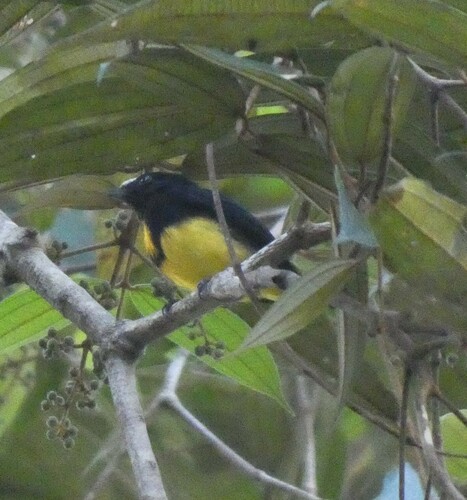 White-fronted ManakinLepidothrix serenaIt is a deep black bird, and is named for its conspicuous bright-white forehead-patch feathers that extend forward beyond the bill's base; the female does not have the patch.
 Cerulean-capped ManakinLepidothrix coeruleocapillaThe cerulean-capped manakin is 8.5 to 9 cm (3.3 to 3.5 in) long and weighs about 9 g (0.32 oz).
Learn the Snow-capped Manakin in the BeakBrain App
Photo and call practice. Coming soon to iPhone and Android.
Play today's Daily BirdEvery photo and recording on this page is credited to its author under the licence shown. Spotted a problem with this page, or have a better photo? Contribute.