Learn what every symbol on the card means.Full credits and sources at beakbrain.com/symbols
 GrasslandCup nestSmall · 27 g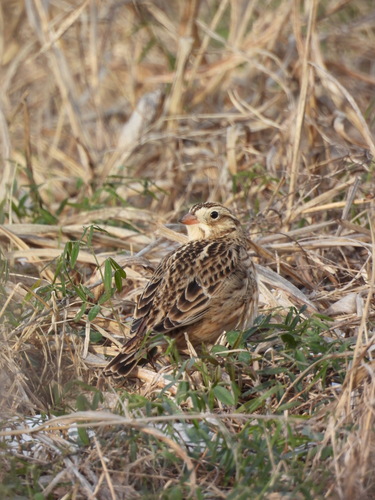
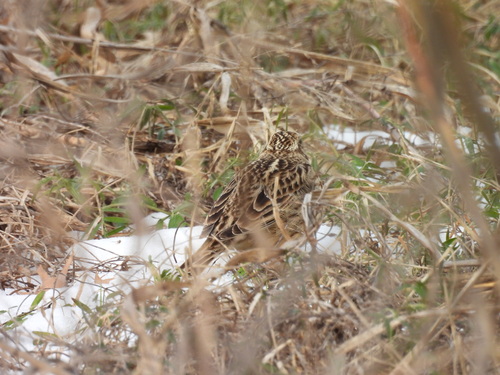


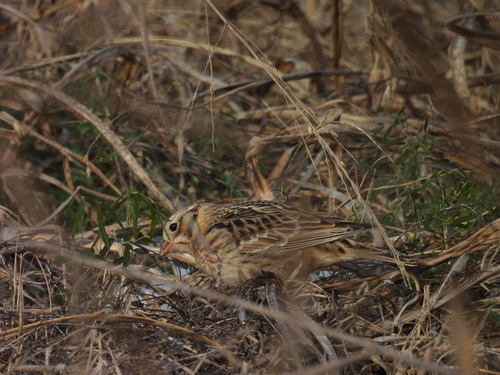
ID tip
These birds have short cone-shaped bills, streaked backs, and dark tails with white outer rectrices. In breeding state plumage (mostly formed by worn basic plumage), the male has a pumpkin-orange throat, nape, and underparts contrasting with an intricate black-and-white face pattern. The white lesser coverts are quite pronounced on a male in spring and early summer. Females and immatures have lightly streaked buffy underparts, dark crowns, brown wings with less obvious white lesser coverts, and a light-colored face. The tail is identical at all ages.
Text from Wikipedia, licensed CC BY-SA 4.0.
When to see the Smith's Longspur
One bar for each month. Filled bars are the 10 months with records; pale bars are months with none. The wide bar is April, the month with the most records.
Where to see the Smith's Longspur
The map shades 2 countries with regular records. Everything unshaded has no records. Countries are listed below the map.
About the Smith's Longspur
Smith's longspur is a bird from the family Calcariidae, which also contains the other species of longspurs. A bird of open habitats, it breeds in northern Canada and Alaska, and winters in the southern United States. Primarily a ground-feeding seed-eater, it supplements its diet with insects in the summer.
Text adapted from Wikipedia, licensed CC BY-SA 4.0.
Easily confused with
 Chestnut-collared LongspurCalcarius ornatusThese birds have a short conical bill, a streaked back and a white tail with a dark tip.
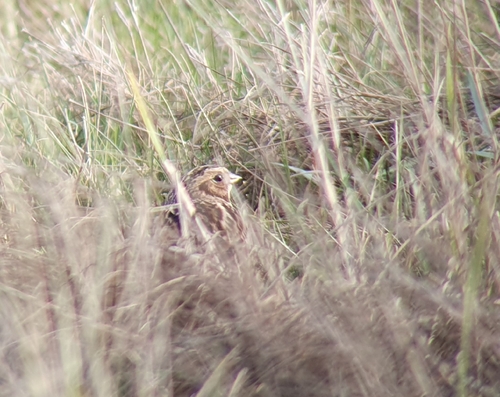 Lapland LongspurCalcarius lapponicusThe Lapland longspur is a robust bird, with a thick yellow seed-eater's bill.
Side by side: Lapland Longspur vs Smith's Longspur · Chestnut-collared Longspur vs Smith's Longspur · Smith's Longspur vs Thick-billed Longspur
Learn the Smith's Longspur in the BeakBrain App
Photo and call practice. Coming soon to iPhone and Android.
Play today's Daily BirdEvery photo and recording on this page is credited to its author under the licence shown. Spotted a problem with this page, or have a better photo? Contribute.