Learn what every symbol on the card means.Full credits and sources at beakbrain.com/symbols
 ShrublandDomed nestTiny · 15 g


ID tip
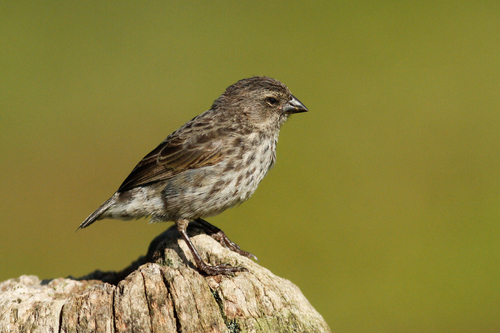
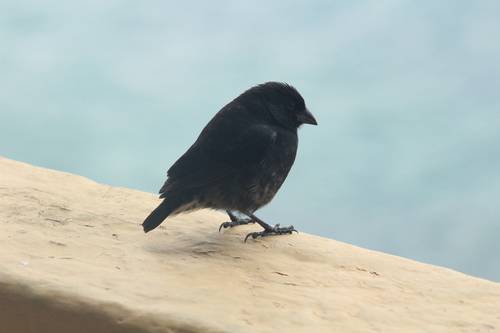
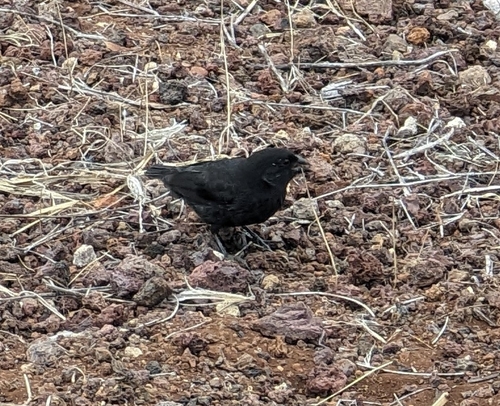
The small ground finch is the smallest of the ground finches, measuring 11 cm (4.3 in) in length. Its beak is short and pointed, with a slightly curved culmen. On average, its beak is smaller than that of the medium ground finch, but there is a significant overlap in size between the two, particularly on islands where only one of the two species exists. On islands where the two species compete directly, the difference between their beaks are greater. The male is black with white-tipped undertail coverts, while the female and young are brown with streaked underparts. Voice: The small ground finch's song is rapid and weak and is transcribed as "twichooo-twichooo" or "teur-weee".
Text from Wikipedia, licensed CC BY-SA 4.0.
When to see the Small Ground Finch
One bar for each month, and every month is filled: this bird is recorded here in all twelve. The wide bar is July, the month with the most records.
Where to see the Small Ground Finch
The map shades 1 country with regular records. Everything unshaded has no records. Countries are listed below the map.
About the Small Ground Finch
The small ground finch is a species of bird in the tanager family Thraupidae. Endemic to the Galápagos Islands, it is common and widespread in shrubland, woodland, and other habitats on most islands in the archipelago. It commonly feeds on small seeds and parasites from the skins of Galápagos land and marine iguanas and Galápagos tortoises.
Text adapted from Wikipedia, licensed CC BY-SA 4.0.
Easily confused with
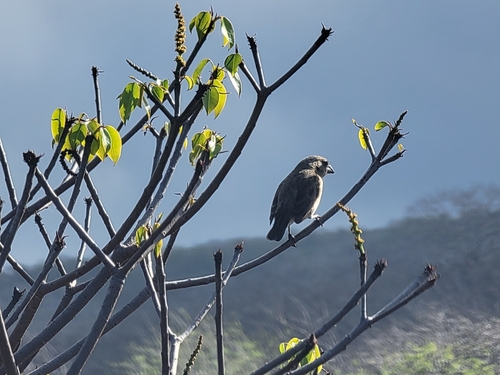 Medium Ground FinchGeospiza fortisLike the other members of its genus, the medium ground finch is strongly sexually dimorphic; the female's plumage is brown and streaky, while the male's is solid black, with white tips to the undertail coverts.
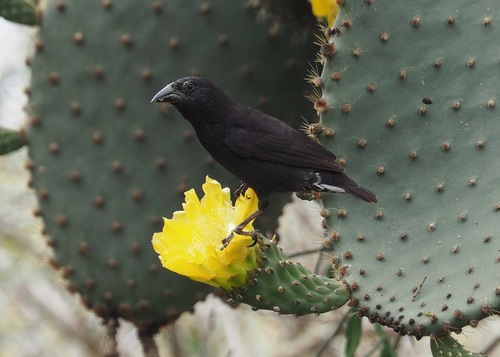 Common Cactus FinchGeospiza scandensThe common cactus finch or small cactus finch is a species of bird in the Darwin's finch group of the tanager family Thraupidae.
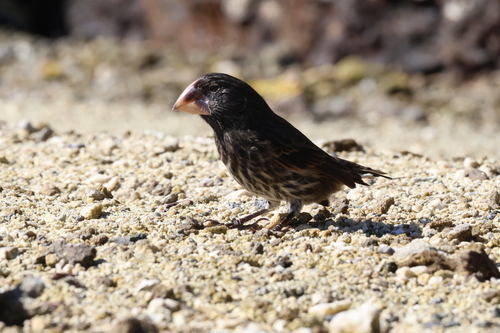 Large Ground FinchGeospiza magnirostrisThe large ground finch weighs about 27–39 g (0.95–1.38 oz), and its length ranges slightly 15–16 cm (5.9–6.3 in).
Side by side: Medium Ground Finch vs Small Ground Finch · Large Ground Finch vs Small Ground Finch
Learn the Small Ground Finch in the BeakBrain App
Photo and call practice. Coming soon to iPhone and Android.
Play today's Daily BirdEvery photo and recording on this page is credited to its author under the licence shown. Spotted a problem with this page, or have a better photo? Contribute.