Learn what every symbol on the card means.Full credits and sources at beakbrain.com/symbols
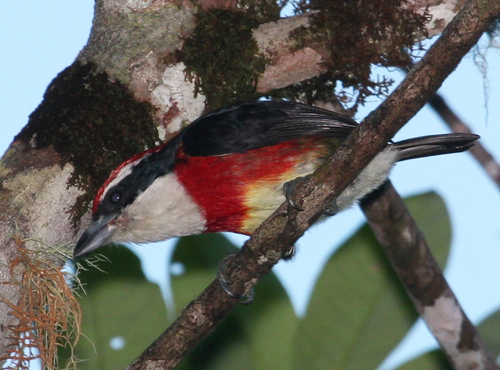

ID tip
The Sira barbet is approximately 19.5 to 20 cm (7.7 to 7.9 in) long and weighs 70 to 79 g (2.5 to 2.8 oz). The adult male's crown and nape are crimson. It has a band of white, fairly wide at the shoulders tapering to the tail; the rest of the upperparts are black. It has a broad white supercilium and a black "mask". The rest of its face, throat, neck, and upper chest are white. A broad crimson band crosses the chest and extends along the flanks where it meets a variable amount of black or gray. The rest of the underparts are white. The female's plumage has minor differences from the male's. Voice: The Sira barbet has a low-pitched purred song. More commonly it emits a Tityra-like grunt. It also makes quiet low-pitched groans and clucks from roost cavities.
Text from Wikipedia, licensed CC BY-SA 4.0.
When to see the Sira Barbet
One bar for each month. Filled bars are the 2 months with records; pale bars are months with none. The wide bar is November, the month with the most records.
About the Sira Barbet
The Sirá barbet is a bird in the family Capitonidae, the New World barbets. It is endemic to the Cerros del Sira of east-central Peru.
Text adapted from Wikipedia, licensed CC BY-SA 4.0.
Easily confused with
 Scarlet-banded BarbetCapito wallaceiThe scarlet-banded barbet is 19.5 cm (7.7 in) long and weighs 65 to 78 g (2.3 to 2.8 oz).
 Brown-chested BarbetCapito brunneipectusThe brown-chested barbet is approximately 18 cm (7.1 in) long; the male weighs approximately 58 g (2.0 oz).
 Five-colored BarbetCapito quinticolorThe five-colored barbet is 17 to 18 cm (6.7 to 7.1 in) long and weighs 54 to 69 g (1.9 to 2.4 oz).
Learn the Sira Barbet in the BeakBrain App
Photo and call practice. Coming soon to iPhone and Android.
Play today's Daily BirdEvery photo and recording on this page is credited to its author under the licence shown. Spotted a problem with this page, or have a better photo? Contribute.