Learn what every symbol on the card means.Full credits and sources at beakbrain.com/symbols
 CoastalCavity nestMedium · 61 g




ID tip
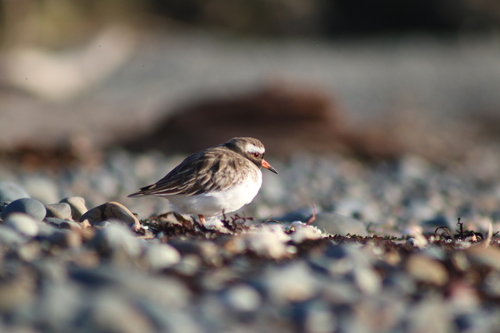
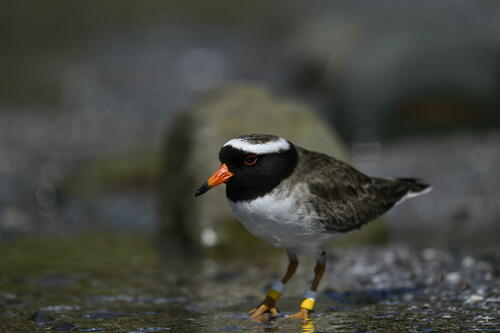
The shore plover is about 20 cm long, brown above and white below, with a black (male) or brown (female) mask; the brown back feathers have narrow pale fringes, giving a scaly appearance at close range. There is a distinctive white strip circling its head below its brown skullcap. Its legs are bright orange-red, and the bill orange-red (brighter in males than females) with a sharply defined dark tip. The wings are brown with a narrow white wingbar along the full length, and the tail brown with white sides.
Text from Wikipedia, licensed CC BY-SA 4.0.
When to see the Shore Plover
One bar for each month. Filled bars are the 10 months with records; pale bars are months with none. The wide bar is March, the month with the most records.
Where to see the Shore Plover
The map shades 1 country with regular records. Everything unshaded has no records. Countries are listed below the map.
About the Shore Plover
The shore plover, also known as the shore dotterel, is a small plover endemic to New Zealand. Once found all around the New Zealand coast, it is now restricted to a few offshore islands. It is one of the world's rarest shorebirds, with a population of roughly 250.
Text adapted from Wikipedia, licensed CC BY-SA 4.0.
Easily confused with
 Black-fronted DotterelThinornis melanopsAs an adult, this small shorebird has an overall length of 16–18 cm (6.3–7.1 in), a wingspan of 33–35 cm (13–14 in) and a weight of 30–35 g (1.1–1.2 oz).
 Forbes's PloverThinornis forbesiThe adult Forbes's plover is 20 cm in length.
 Three-banded PloverThinornis tricollarisThe adult three-banded plover is 18 cm in length.
Learn the Shore Plover in the BeakBrain App
Photo and call practice. Coming soon to iPhone and Android.
Play today's Daily BirdEvery photo and recording on this page is credited to its author under the licence shown. Spotted a problem with this page, or have a better photo? Contribute.