Learn what every symbol on the card means.Full credits and sources at beakbrain.com/symbols
 ForestSmall · 30 g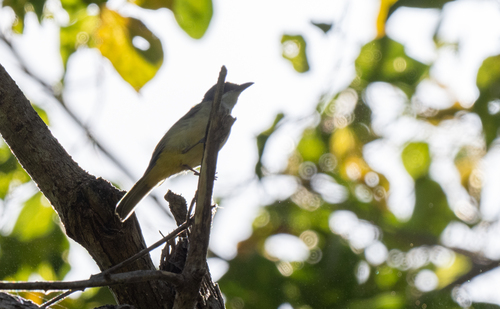


ID tip
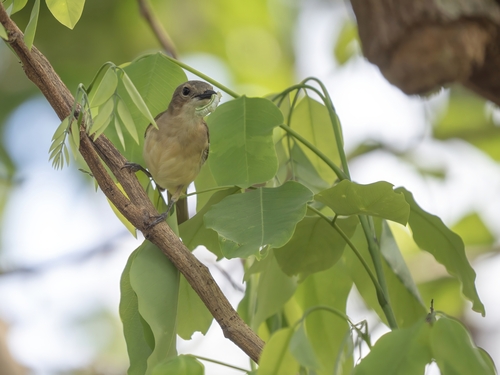
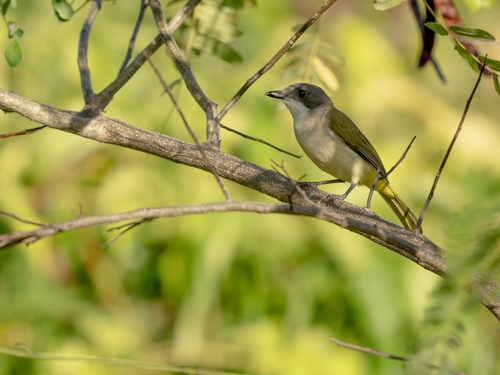
Adult Selayar whistlers are around 16–17 cm (6.3–6.7 in) in length. Adult males have grey heads from the crown down to the lores, ear-coverts, and nape (back of the neck), with white throats. The upperparts are olive-green, with a yellower tint on the rump, while the tail and wing feathers are brownish-olive with dark olive-green margins. The underparts are pinkish, with a yellowish hue to the belly. The iris is dark brown, the beak is black, and the legs are greyish-brown. Adult females are similar, but have dark ochre lores and rufous ear-coverts.
Text from Wikipedia, licensed CC BY-SA 4.0.
When to see the Selayar Whistler
One bar for each month. Filled bars are the 5 months with records; pale bars are months with none. The wide bar is September, the month with the most records.
Where to see the Selayar Whistler
The map shades 1 country with regular records. Everything unshaded has no records. Countries are listed below the map.
About the Selayar Whistler
The Selayar whistler is a species of songbird in the family Pachycephalidae. Described by the Swiss zoologist Johann Büttikofer in 1878, it is endemic to the Indonesian island of Selayar, off the southwestern coast of Sulawesi. After its initial description, it was long considered a subspecies of the golden whistler and later the rusty-breasted whistler, before being raised to species status again in 2016. Selayar whistlers are around 16–17 cm (6.3–6.7 in) in length. Adult males have grey heads, white throats, olive-green upperparts, pinkish underparts, and brownish-olive tail and wing feathers.
Text adapted from Wikipedia, licensed CC BY-SA 4.0.
Easily confused with
Learn the Selayar Whistler in the BeakBrain App
Photo and call practice. Coming soon to iPhone and Android.
Play today's Daily BirdEvery photo and recording on this page is credited to its author under the licence shown. Spotted a problem with this page, or have a better photo? Contribute.