Learn what every symbol on the card means.Full credits and sources at beakbrain.com/symbols
 GrasslandDomed nestTiny · 9 g


What the Sedge Wren sounds like


ID tip
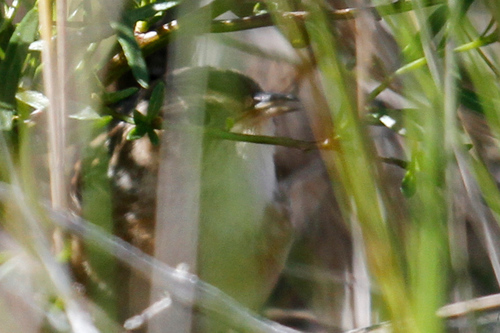
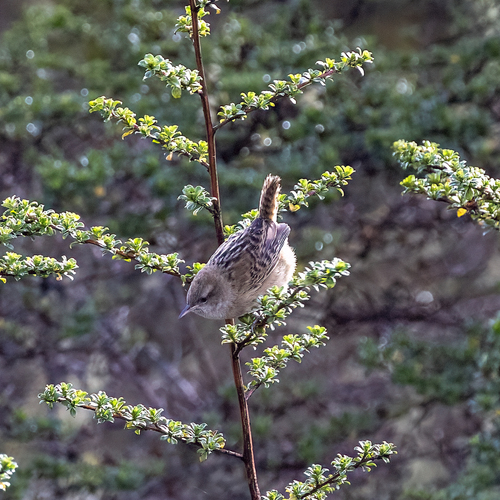
The sedge wren is a relatively small wren that measures 10 to 12 cm (3.9 to 4.7 in), weighs 7 to 10 g (0.25 to 0.35 oz) and has a wing-chord of 4.1 to 4.6 cm (1.6 to 1.8 in). Wingspan ranges from 4.7 to 5.5 in (12-14 cm). Females and males have the same plumage but males are slightly larger. Their head and back are tawny brown streaked with black and white. They have a pale buff supercilium and brown irises. Their rump is orange and tail is tawny brown bared with black. Wings are tawny brown bared with black, white and pale buff. They have a white throat and belly with pale buff on the side. Voice: Songs usually last 1.5 to 2 seconds and start with 3 to 4 high notes or staccato chips followed by a series of thrills. While both male and females can produce calls, only the males sing. Males sing from late winter to early spring on non-breeding grounds and throughout the breeding season to attract mates. They sing both during the day and the night.
Text from Wikipedia, licensed CC BY-SA 4.0.
When to see the Sedge Wren
One bar for each month. Filled bars are the 9 months with records; pale bars are months with none. The wide bar is May, the month with the most records.
Where to see the Sedge Wren
The map shades 2 countries with regular records, and 2 more in a lighter tone where the bird turns up only as a stray. Everything unshaded has no records. Countries are listed below the map.
About the Sedge Wren
The sedge wren is a small and secretive passerine bird in the family Troglodytidae. It is widely distributed in North America. It is often found in wet grasslands and meadows where it nests in the tall grasses and sedges and feeds on insects. The sedge wren was formerly considered as conspecific with the non-migratory grass wren of central and South America.
Text adapted from Wikipedia, licensed CC BY-SA 4.0.
Easily confused with
Learn the Sedge Wren in the BeakBrain App
Photo and call practice. Coming soon to iPhone and Android.
Play today's Daily BirdEvery photo and recording on this page is credited to its author under the licence shown. Spotted a problem with this page, or have a better photo? Contribute.