Learn what every symbol on the card means.Full credits and sources at beakbrain.com/symbols
 ForestCavity nestLarge · 1.0 kg


What the Scarlet Macaw sounds like

ID tip
It is about 84 centimeters (33 in) long, of which more than half is the pointed, graduated tail typical of all macaws, though the scarlet macaw has a larger percentage of tail than the other large macaws. The average weight is about 1 kilogram (2 lb 3 oz). The plumage is mostly scarlet, but the rump and tail-covert feathers are light blue, the greater upper wing coverts are yellow, the upper sides of the flight feathers of the wings are dark blue as are the ends of the tail feathers, and the undersides of the wing and tail flight feathers are dark red with metallic gold iridescence.
Text from Wikipedia, licensed CC BY-SA 4.0.
When to see the Scarlet Macaw
One bar for each month, and every month is filled: this bird is recorded here in all twelve. The wide bar is March, the month with the most records.
Where to see the Scarlet Macaw
The map shades 15 countries with regular records, and 10 more in a lighter tone where the bird turns up only as a stray. Everything unshaded has no records. Countries are listed below the map.
Recorded as a rare visitor in United States, Belize, Guatemala, Puerto Rico, France, Netherlands, Australia, Argentina, Guadeloupe, Maldives.
About the Scarlet Macaw
The scarlet macaw also called the red-and-yellow macaw, red-and-blue macaw or red-breasted macaw, is a large yellow, green, red and blue Neotropical parrot native to humid evergreen forests of the Americas. Its range extends from southeastern Mexico to Peru, Ecuador, Colombia, Bolivia, Venezuela, Honduras, and Brazil in lowlands of 500 m (1,600 ft) up to 1,000 m (3,300 ft), the Caribbean island of Trinidad, as well as the Pacific island of Coiba. Formerly, the northern extent of its range included southern Tamaulipas. In some areas, it has suffered local extinction because of habitat destruction, or capture for the parrot trade, but in other areas, it remains fairly common.
Text adapted from Wikipedia, licensed CC BY-SA 4.0.
Easily confused with
 Chestnut-fronted MacawAra severusThe chestnut-fronted or severe macaw is mostly green in colour with patches of red and blue on the wings.
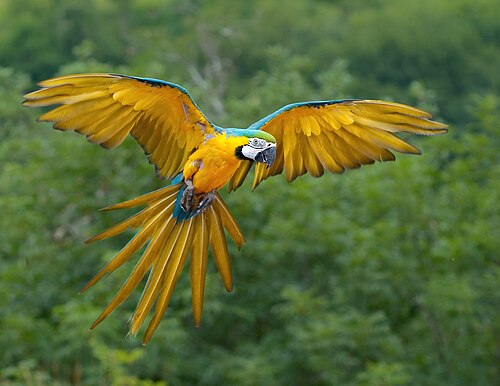 Blue-and-yellow MacawAra araraunaThese birds can reach a length of 81–91 cm (32–36 in) and weigh 1.0–1.5 kg (2–3 lb), making them some of the larger members of their family.
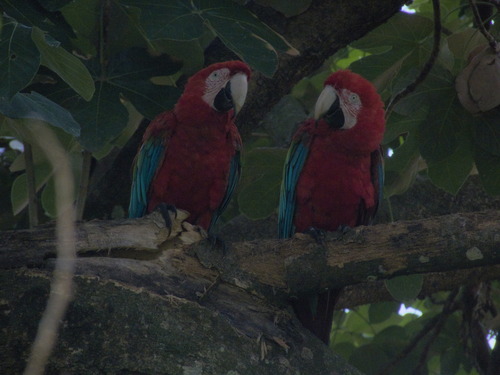 Red-and-green MacawAra chloropterusThe green-winged macaw can be readily distinguished from the scarlet macaw.
Side by side: Chestnut-fronted Macaw vs Scarlet Macaw · Blue-and-yellow Macaw vs Scarlet Macaw · Red-and-green Macaw vs Scarlet Macaw
Watch the Scarlet Macaw on live cams
 LIVE
LIVEBrowse all 118 bird cams worldwide, live and seasonal, by region and species.
Learn the Scarlet Macaw in the BeakBrain App
Photo and call practice. Coming soon to iPhone and Android.
Play today's Daily BirdEvery photo and recording on this page is credited to its author under the licence shown. Spotted a problem with this page, or have a better photo? Contribute.