Learn what every symbol on the card means.Full credits and sources at beakbrain.com/symbols
 WoodlandCavity nestTiny · 10 g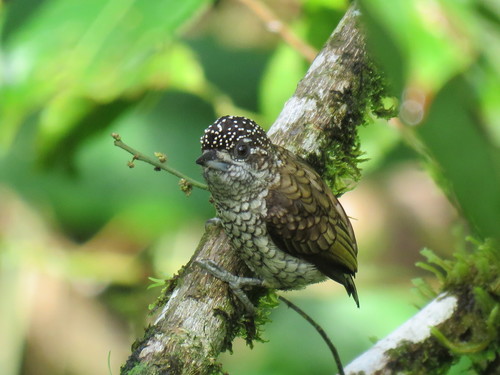
ID tip
The scaled piculet is 8 to 9.2 cm (3.1 to 3.6 in) long and weighs 7 to 12 g (0.25 to 0.42 oz). Adult males of the nominate subspecies P. s. squamulatus have a black cap with red feather tips on the forehead and white ones on the rest of it. Their face is mostly brown with black tips on some feathers and a whitish line behind the eye. Their upperparts are olive brown with a scaly appearance due to narrow black borders on the feathers. Their flight feathers are brown with yellowish edges on the secondaries and tertials.
Text from Wikipedia, licensed CC BY-SA 4.0.
When to see the Scaled Piculet
One bar for each month, and every month is filled: this bird is recorded here in all twelve. The wide bar is May, the month with the most records.
Where to see the Scaled Piculet
The map shades 2 countries with regular records. Everything unshaded has no records. Countries are listed below the map.
About the Scaled Piculet
The scaled piculet is a species of bird in subfamily Picumninae of the woodpecker family Picidae. It is found in Colombia and Venezuela.
Text adapted from Wikipedia, licensed CC BY-SA 4.0.
Easily confused with
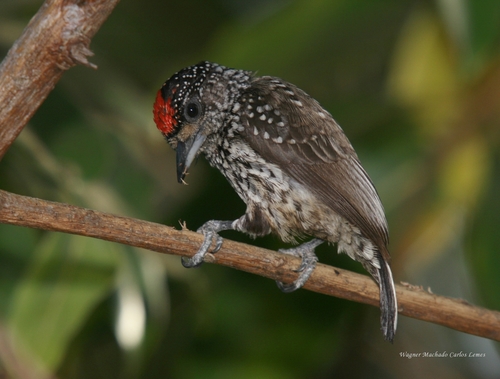 White-wedged PiculetPicumnus albosquamatusThe white-wedged piculet is 10 to 11 cm (3.9 to 4.3 in) long and weighs 9 to 11 g (0.32 to 0.39 oz).
 Speckled PiculetPicumnus innominatusThe male and female birds look alike.
 Greyish PiculetPicumnus granadensisThe greyish piculet is 9 to 10 cm (3.5 to 3.9 in) long and weighs 12 to 13 g (0.42 to 0.46 oz).
Side by side: Ochre-collared Piculet vs Scaled Piculet · Scaled Piculet vs Speckled Piculet · Scaled Piculet vs White-wedged Piculet · Greyish Piculet vs Scaled Piculet
Learn the Scaled Piculet in the BeakBrain App
Photo and call practice. Coming soon to iPhone and Android.
Play today's Daily BirdEvery photo and recording on this page is credited to its author under the licence shown. Spotted a problem with this page, or have a better photo? Contribute.