Learn what every symbol on the card means.Full credits and sources at beakbrain.com/symbols
 ForestScrapeMedium · 104 g

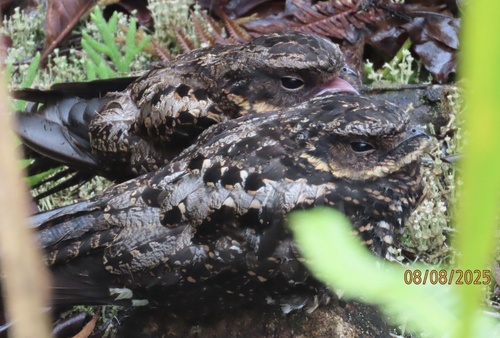
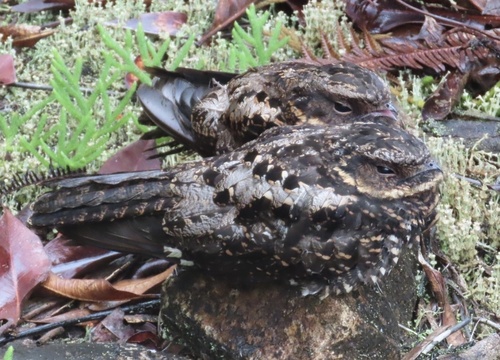
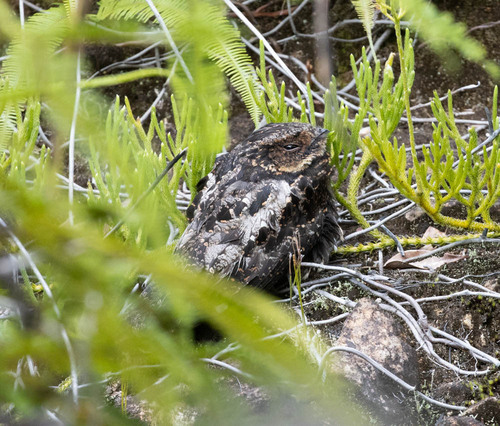
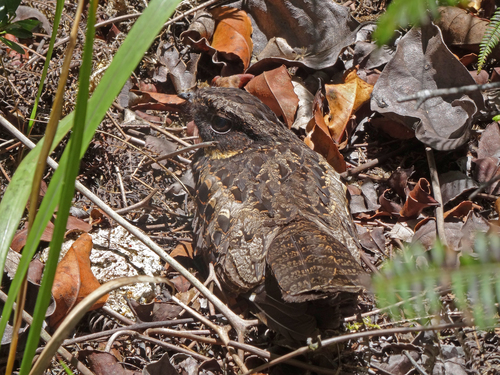
ID tip
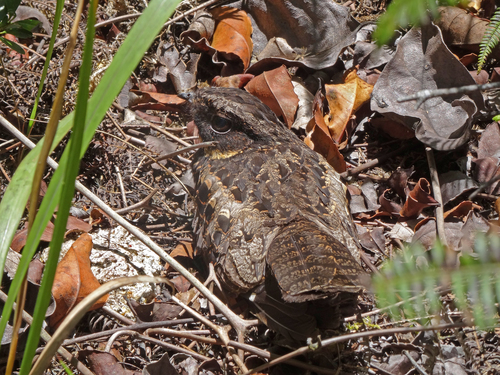
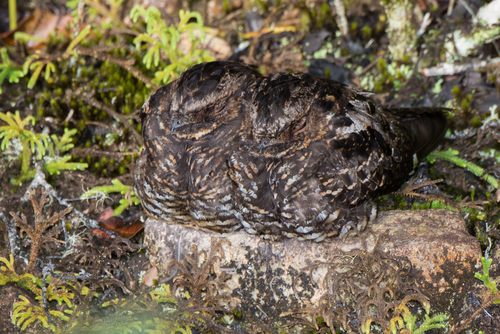
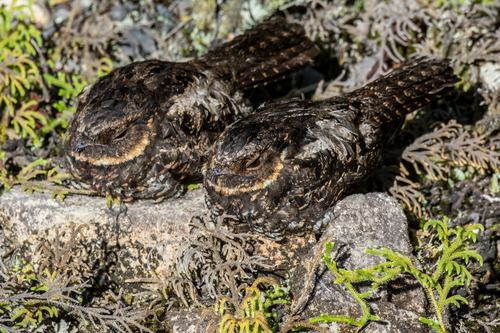
The Satanic nightjar measures about 27 cm (11 in) long. It has a white to buff-colored collar at its throat, blackish head, greyish-brown back, barred brown belly, and white spots on its 3rd and 4th outer primaries. It can be distinguished from other nightjars in the area by its dark color and the absence of ear tufts, white tail, and wing patches. Voice: The Satanic nightjar makes a range of different vocalizations. While flying, the bird produces a burst of loud, ascending, "fWIP! fWIP" notes set at 1 second intervals. These notes can also occur more sporadically, sometimes sung suddenly and close-together in pairs of "fWIP-WIK!, fWIP-WIK!" where the last note is shorter and sharper than the first.
Text from Wikipedia, licensed CC BY-SA 4.0.
When to see the Satanic Nightjar
One bar for each month. Filled bars are the 5 months with records; pale bars are months with none. The wide bar is September, the month with the most records.
Where to see the Satanic Nightjar
The map shades 1 country with regular records. Everything unshaded has no records. Countries are listed below the map.
About the Satanic Nightjar
The Satanic nightjar, also Heinrich's nightjar, satanic eared-nightjar, Sulawesi eared-nightjar, Satanic goatsucker or diabolical nightjar is a mid-sized, spotted, dark brown nightjar endemic to the Indonesian island of Sulawesi. The species was discovered in 1931 by Gerd Heinrich, a German natural historian who collected a single female holotype from Mount Klabat on the Minahasa peninsula of Northern Sulawesi.
Text adapted from Wikipedia, licensed CC BY-SA 4.0.
Easily confused with
Learn the Satanic Nightjar in the BeakBrain App
Photo and call practice. Coming soon to iPhone and Android.
Play today's Daily BirdEvery photo and recording on this page is credited to its author under the licence shown. Spotted a problem with this page, or have a better photo? Contribute.