Learn what every symbol on the card means.Full credits and sources at beakbrain.com/symbols
 ForestTiny · 3 g


ID tip
The Santa Marta woodstar is about 7 cm (2.8 in) long. Both sexes have a straight black bill. The male's head is shiny green and the rest of the upperparts dark shiny bluish. It has a reddish gorget that extends across the neck. The breast is gray and the belly bluish with a white spot on the flanks. The tail is forked, with very short central feathers and outer ones that are bare shafts. The female is bronzy green above and pale cinnamon-rufous below with a dark cheek patch and, like the male, a white spot on the flanks. Voice: The Santa Marta woodstar's vocalizations have seldom been recorded. What is possibly its song is "a regularly repeated, single, modulated squeaky note." It makes "a series of single liquid 'tsit' notes or a doubled 'ti-tsit'" calls while hovering or feeding.
Text from Wikipedia, licensed CC BY-SA 4.0.
When to see the Santa Marta Woodstar
One bar for each month. Filled bars are the 9 months with records; pale bars are months with none. The wide bar is December, the month with the most records.
Where to see the Santa Marta Woodstar
The map shades 1 country with regular records. Everything unshaded has no records. Countries are listed below the map.
About the Santa Marta Woodstar
The Santa Marta woodstar is a species of hummingbird in tribe Mellisugini of subfamily Trochilinae, the "bee hummingbirds". It is endemic to Colombia.
Text adapted from Wikipedia, licensed CC BY-SA 4.0.
Easily confused with
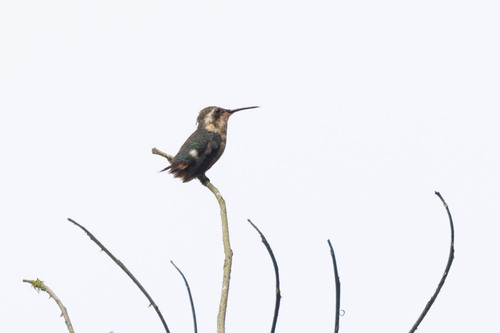 Little WoodstarChaetocercus bombusThe little woodstar is 6 to 7 cm (2.4 to 2.8 in) long.
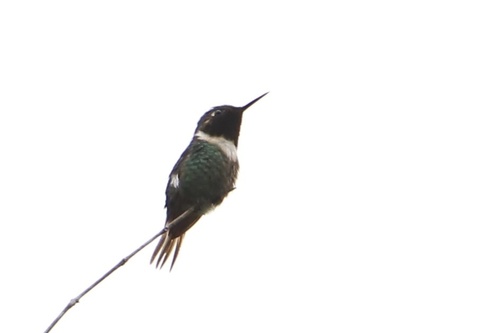 Rufous-shafted WoodstarChaetocercus jourdaniiThe rufous-shafted woodstar is 6 to 8 cm (2.4 to 3.1 in) long.
 Esmeraldas WoodstarChaetocercus berlepschiAt only about 6 centimeters long, Esmeraldas woodstars are among the smallest species of hummingbird.
Learn the Santa Marta Woodstar in the BeakBrain App
Photo and call practice. Coming soon to iPhone and Android.
Play today's Daily BirdEvery photo and recording on this page is credited to its author under the licence shown. Spotted a problem with this page, or have a better photo? Contribute.