Learn what every symbol on the card means.Full credits and sources at beakbrain.com/symbols
 ForestLarge · 1.1 kg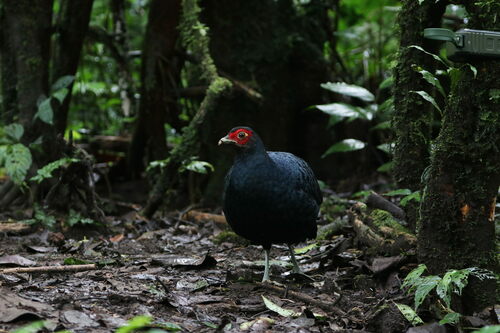

ID tip
The male and female Salvadori's pheasant are quite unlike each other in appearance, and in fact the male bird is very similar to the female crestless fireback (Lophura erythrophthalma). The male Salvadori's pheasant is 46 to 55 cm (18 to 22 in) in length and is plain black, with a bluish fringe to the feathers of body and neck. The tail is short and rounded. The beak is whitish-green and the iris orange-red. There is a yellowish-green or grey-green ring of bare skin round the eye, and the rest of the bare facial skin is bright red. The legs are greyish-blue with a strong spur.
Text from Wikipedia, licensed CC BY-SA 4.0.
When to see the Salvadori's Pheasant
One bar for each month. Filled bars are the 7 months with records; pale bars are months with none. The wide bar is July, the month with the most records.
Where to see the Salvadori's Pheasant
The map shades 1 country with regular records. Everything unshaded has no records. Countries are listed below the map.
About the Salvadori's Pheasant
Salvadori's pheasant is a landfowl bird of genus Lophura, native to Indonesia. It is found in the mountain rainforests of Sumatra. Thus it is also known as the Sumatran pheasant. This bird was first described in 1879 by the Italian ornithologist Tommaso Salvadori. The species name inornata means "without ornament". The Hoogerwerf's pheasant is usually thought to be a subspecies.
Text adapted from Wikipedia, licensed CC BY-SA 4.0.
Easily confused with
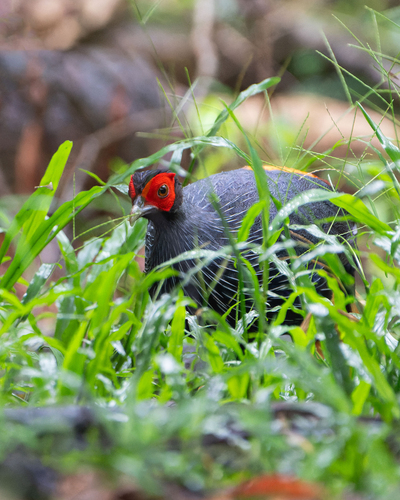 Malayan Crestless FirebackLophura erythrophthalmaThe Malayan crestless fireback or Malay crestless fireback is a member of the family Phasianidae.
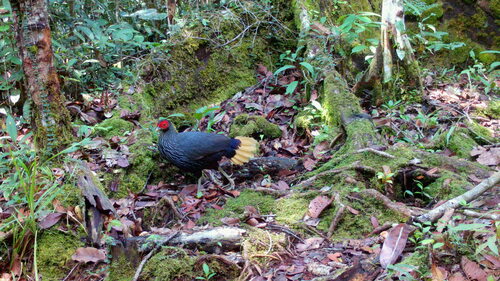 Bornean Crestless FirebackLophura pyronotaThe Bornean crestless fireback is a member of the Phasianidae.
 Malayan Crested FirebackLophura rufaIt is a medium-sized, up to 70 cm long pheasant with a peacock-like dark crest, bluish black plumage, reddish brown rump, black outer tail feathers, red iris and bare blue facial skin.
Learn the Salvadori's Pheasant in the BeakBrain App
Photo and call practice. Coming soon to iPhone and Android.
Play today's Daily BirdEvery photo and recording on this page is credited to its author under the licence shown. Spotted a problem with this page, or have a better photo? Contribute.