Learn what every symbol on the card means.Full credits and sources at beakbrain.com/symbols
 ForestSmall · 36 g


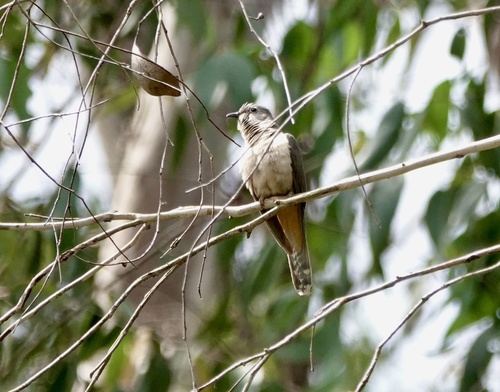
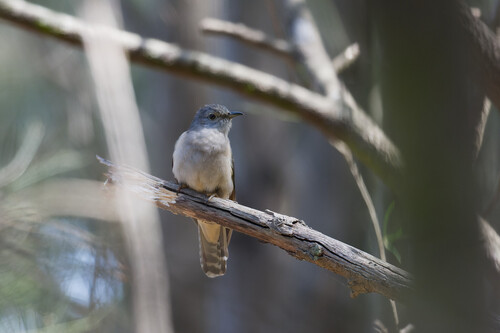
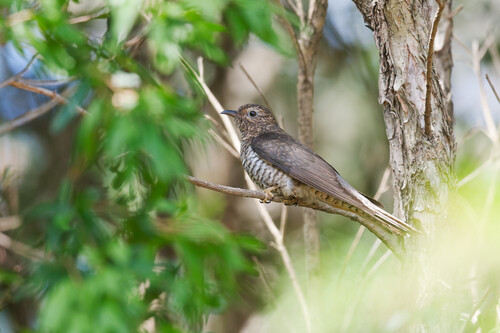
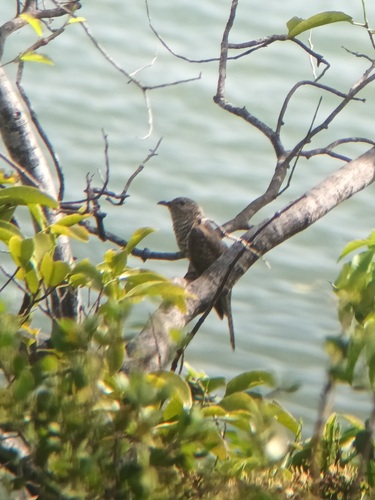
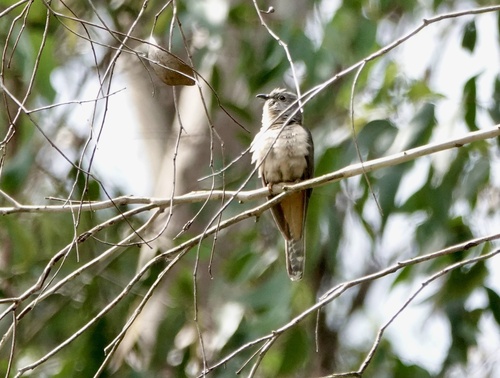
ID tip
The Sahul brush cuckoo is about 22–26 cm (8.7–10.2 in) long. The plumage of adult males and females is similar. The head is pale grey, the breast is buff, the back is grey-brown, and the underside of the tail is brown with white tips and bars. The eye has a narrow, pale ring around it, and the feet are olive-pink. Juvenile plumage is heavily barred dark brown. The wings are sharply pointed and backswept in flight. Underwings are grey-brown with pale buff underwing coverts and a white or pale buff bar.
Text from Wikipedia, licensed CC BY-SA 4.0.
When to see the Sahul Brush Cuckoo
One bar for each month. Filled bars are the 10 months with records; pale bars are months with none. The wide bar is November, the month with the most records.
Where to see the Sahul Brush Cuckoo
The map shades 8 countries with regular records. Everything unshaded has no records. Countries are listed below the map.
About the Sahul Brush Cuckoo
The Sahul brush cuckoo, formerly known as the brush cuckoo, is a member of the cuckoo family. It is native to Malesia, New Guinea, the Solomon Islands and northern and eastern Australia. It is a grey-brown bird with a buff breast. Its call is a familiar sound of the Australian and Indonesian bush.
Text adapted from Wikipedia, licensed CC BY-SA 4.0.
Easily confused with
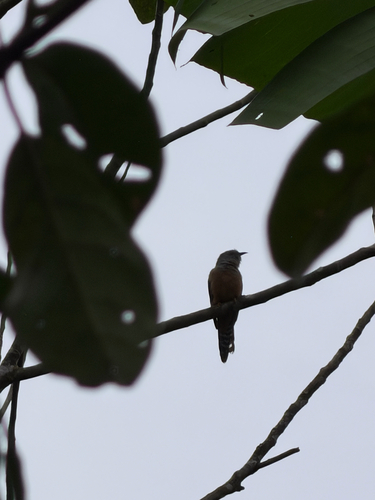 Plaintive CuckooCacomantis merulinusThe plaintive cuckoo is fairly small, measuring about 21–24 cm (8.3–9.4 in) long.
 Grey-bellied CuckooCacomantis passerinusThe grey-bellied cuckoo is one of the smaller cuckoos, at a total length of about 23 cm.
 Banded Bay CuckooCacomantis sonneratiiThe adults are bright rufous or bay on the head and back and are broadly barred with dark brown.
Side by side: Fan-tailed Cuckoo vs Sahul Brush Cuckoo · Channel-billed Cuckoo vs Sahul Brush Cuckoo · Plaintive Cuckoo vs Sahul Brush Cuckoo · Grey-bellied Cuckoo vs Sahul Brush Cuckoo · Banded Bay Cuckoo vs Sahul Brush Cuckoo
Learn the Sahul Brush Cuckoo in the BeakBrain App
Photo and call practice. Coming soon to iPhone and Android.
Play today's Daily BirdEvery photo and recording on this page is credited to its author under the licence shown. Spotted a problem with this page, or have a better photo? Contribute.