Learn what every symbol on the card means.Full credits and sources at beakbrain.com/symbols
 ShrublandCup nestSmall · 19 g


ID tip
The sagebrush sparrow is about 12 to 15 cm (4.7 to 5.9 in) long and weighs about 15 to 22 g (0.53 to 0.78 oz). Males are larger than females but the sexes have the same plumage. Adults in fresh plumage have a mostly pale to medium gray head and nape. They have dusky gray lores, a white to buff-white patch above them, a white eye-ring, and sometimes a faint white supercilium and dark line behind the eye. They have a white streak below the ear coverts with sometimes a thin black stripe below it. Their back, rump, and uppertail coverts are brownish with fuscous streaks on the back. Voice: Only male sagebrush sparrows sing, and do so throughout the breeding season. The song is described as a "series of short musical buzzes on different frequencies with abrupt beginnings and endings". Males sing from atop a shrub or just below its top. The species' contact call is a "short musical tink" that often is repeated. It also makes a "sharper and shorter" warning call.
Text from Wikipedia, licensed CC BY-SA 4.0.
When to see the Sagebrush Sparrow
One bar for each month, and every month is filled: this bird is recorded here in all twelve. The wide bar is June, the month with the most records.
Where to see the Sagebrush Sparrow
The map shades 2 countries with regular records, and 1 more in a lighter tone where the bird turns up only as a stray. Everything unshaded has no records. Countries are listed below the map.
Recorded as a rare visitor in Canada.
About the Sagebrush Sparrow
The sagebrush sparrow is a species of bird in the family Passerellidae, the New World sparrows. It is found in Mexico and the United States.
Text adapted from Wikipedia, licensed CC BY-SA 4.0.
Easily confused with
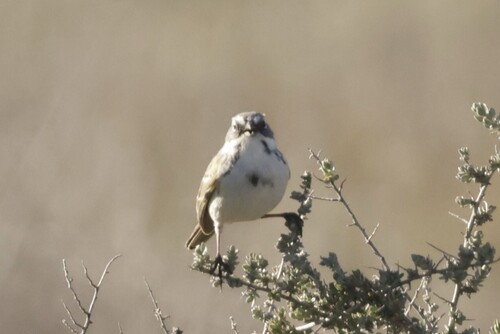
Side by side: Bell's Sparrow vs Sagebrush Sparrow
Learn the Sagebrush Sparrow in the BeakBrain App
Photo and call practice. Coming soon to iPhone and Android.
Play today's Daily BirdEvery photo and recording on this page is credited to its author under the licence shown. Spotted a problem with this page, or have a better photo? Contribute.