Learn what every symbol on the card means.Full credits and sources at beakbrain.com/symbols
 ShrublandScrapeHuge · 1.9 kg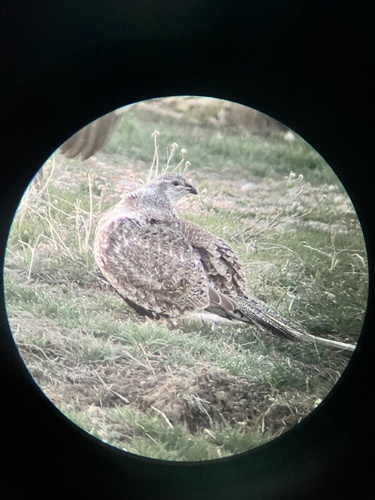


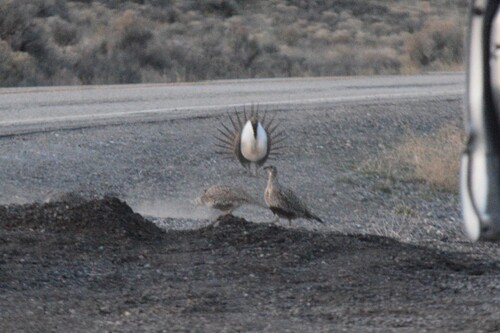
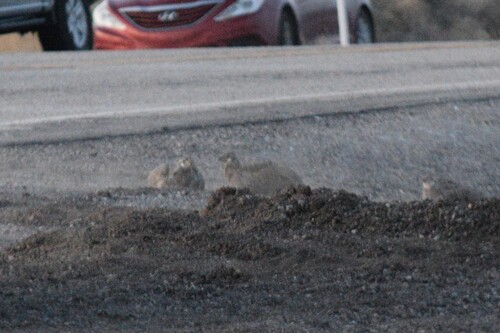
ID tip
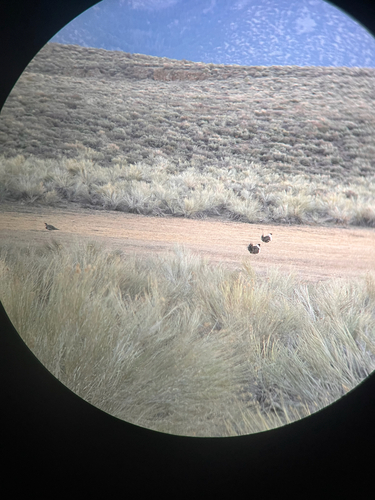
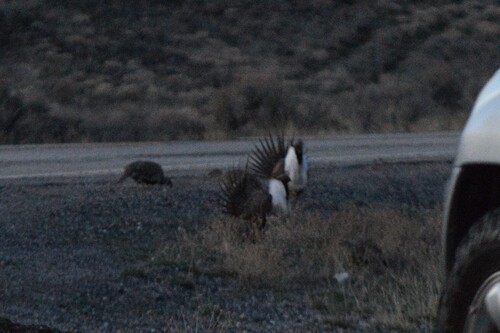
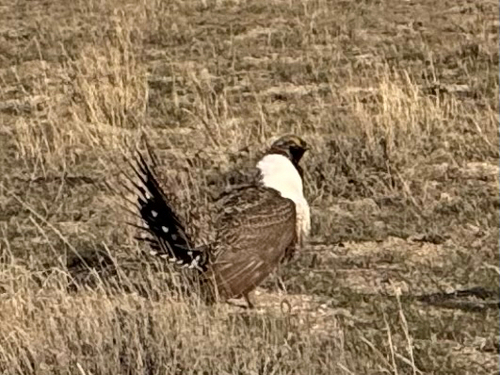
Adult greater sage-grouse have a long, pointed tail and legs with feathers to the toes. The adult male has a yellow patch over each eye, is grayish on top with a white breast, and has a dark brown throat and a black belly; two yellowish sacs on the neck are inflated during courtship display. The adult female is mottled gray-brown with a light brown throat and dark belly. Adult males range in length from 66–76 cm (26–30 in) and weigh between 2.3–3.2 kg (5.1–7.1 lb). Adult females are smaller, ranging in length from 48–58 cm (19–23 in) and weighing between 1.3–1.75 kg (2.9–3.9 lb).
Text from Wikipedia, licensed CC BY-SA 4.0.
When to see the Sage Grouse
One bar for each month. Filled bars are the 7 months with records; pale bars are months with none. The wide bar is April, the month with the most records.
Where to see the Sage Grouse
The map shades 1 country with regular records, and 1 more in a lighter tone where the bird turns up only as a stray. Everything unshaded has no records. Countries are listed below the map.
Recorded as a rare visitor in Canada.
About the Sage Grouse
The greater sage-grouse, also known as the sagehen, is the largest grouse in North America. Its range is sagebrush country in the western United States and southern Alberta and Saskatchewan, Canada. It was known as simply the sage grouse until the Gunnison sage-grouse was recognized as a separate species in 2000. The Mono Basin population of sage grouse may also be distinct.
Text adapted from Wikipedia, licensed CC BY-SA 4.0.
Easily confused with

Learn the Sage Grouse in the BeakBrain App
Photo and call practice. Coming soon to iPhone and Android.
Play today's Daily BirdEvery photo and recording on this page is credited to its author under the licence shown. Spotted a problem with this page, or have a better photo? Contribute.