Learn what every symbol on the card means.Full credits and sources at beakbrain.com/symbols
 ShrublandCavity nestSmall · 17 g


What the Saffron Finch sounds like


ID tip
The male is bright yellow with an orange crown which distinguishes it from most other yellow finches (the exception being the orange-fronted yellow finch). The females are more difficult to identify and are usually just a slightly duller version of the male, but in the southern subspecies S. f. pelzelni they are olive-brown with heavy dark streaks.
Text from Wikipedia, licensed CC BY-SA 4.0.
When to see the Saffron Finch
One bar for each month, and every month is filled: this bird is recorded here in all twelve. The wide bar is October, the month with the most records.
Where to see the Saffron Finch
The map shades 19 countries with regular records, and 3 more in a lighter tone where the bird turns up only as a stray. Everything unshaded has no records. Countries are listed below the map.
Recorded as a rare visitor in Taiwan, Canada, French Guiana.
About the Saffron Finch
The saffron finch is a tanager from South America that is common in open and semi-open areas in lowlands outside the Amazon Basin. They have a wide distribution in Colombia, northern Venezuela, western Ecuador, western Peru, eastern and southern Brazil, Bolivia, Paraguay, Uruguay, northern Argentina, and Trinidad and Tobago. It has also been introduced to Hawaii, Panama, Puerto Rico, Jamaica and elsewhere. Although commonly regarded as a canary, it is not related to the Atlantic canary. Formerly, it was placed in the Emberizidae but it is close to the seedeaters.
Text adapted from Wikipedia, licensed CC BY-SA 4.0.
Easily confused with
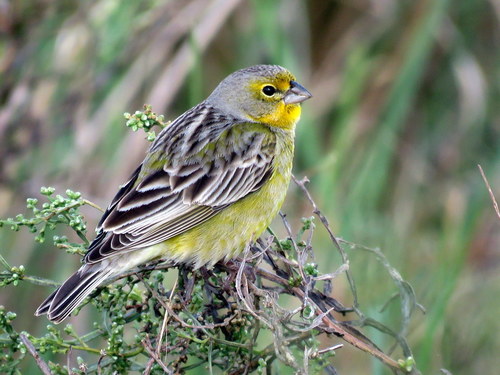 Grassland Yellow FinchSicalis luteolaThe grassland yellow finch is a small passerine bird.
 Greenish Yellow FinchSicalis olivascensThe greenish yellow finch is a species of bird in the family Thraupidae.
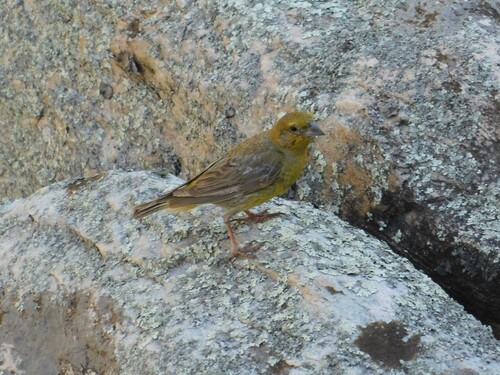 Greater Yellow FinchSicalis auriventrisThe greater yellow finch is a species of bird in the family Thraupidae.
Side by side: Bananaquit vs Saffron Finch
Learn the Saffron Finch in the BeakBrain App
Photo and call practice. Coming soon to iPhone and Android.
Play today's Daily BirdEvery photo and recording on this page is credited to its author under the licence shown. Spotted a problem with this page, or have a better photo? Contribute.