Learn what every symbol on the card means.Full credits and sources at beakbrain.com/symbols
 ForestCup nestTiny · 4 g



What the Rufous-vented Whitetip sounds like

ID tip
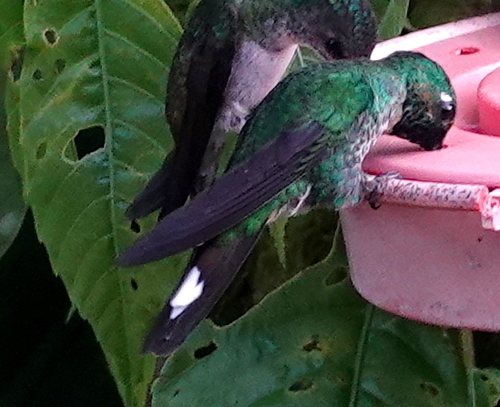
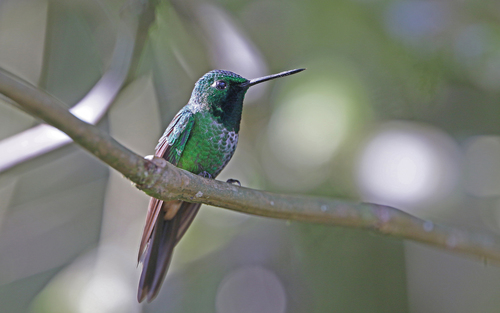
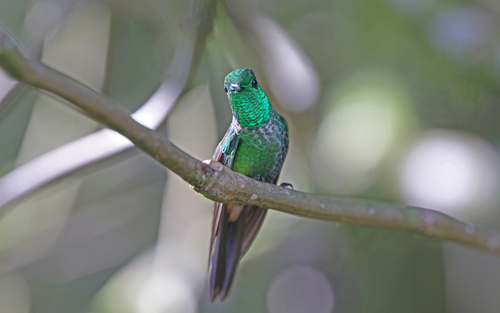
The rufous-vented whitetip is 9 to 10 cm (3.5 to 3.9 in) long and weighs 4 to 4.2 g (0.14 to 0.15 oz). Both sexes have a medium-length straight black bill and a prominent white stripe behind the eye. Both have shining green upperparts and a forked tail, though the female's is not as deeply indented as the male's. Males have shining green underparts with buffy undertail coverts. The tail is dusky bronze; the central feathers have wide white tips. Females have white underparts spotted with green. The tail is dusky bronze with white tips on the outermost feathers. Voice: The rufous-vented whitetip makes a "mellow, fast twittering 'tweetweetweetwee...'" that can sound like "a laughing chatter". While feeding in flight it also makes "a single lower-pitched scratchy note 'tzrrrrr'".
Text from Wikipedia, licensed CC BY-SA 4.0.
When to see the Rufous-vented Whitetip
One bar for each month. Filled bars are the 11 months with records; pale bars are months with none. The wide bar is July, the month with the most records.
Where to see the Rufous-vented Whitetip
The map shades 3 countries with regular records. Everything unshaded has no records. Countries are listed below the map.
About the Rufous-vented Whitetip
The rufous-vented whitetip is a species of hummingbird in the "brilliants", tribe Heliantheini in subfamily Lesbiinae. It is found in Colombia, Ecuador and Peru.
Text adapted from Wikipedia, licensed CC BY-SA 4.0.
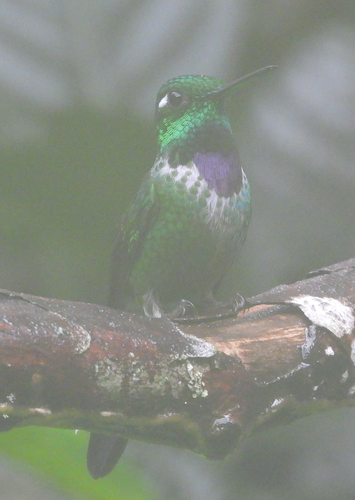
Easily confused with
Learn the Rufous-vented Whitetip in the BeakBrain App
Photo and call practice. Coming soon to iPhone and Android.
Play today's Daily BirdEvery photo and recording on this page is credited to its author under the licence shown. Spotted a problem with this page, or have a better photo? Contribute.