Learn what every symbol on the card means.Full credits and sources at beakbrain.com/symbols
 WoodlandPlatform nestMedium · 292 g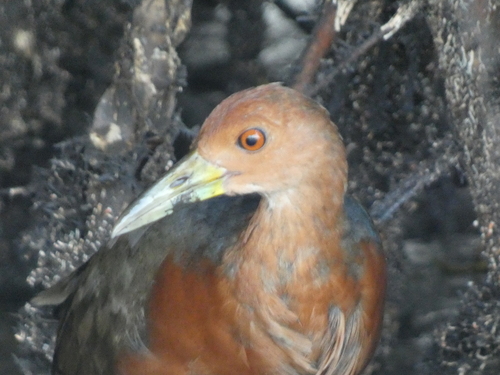


What the Rufous-necked Wood Rail sounds like

ID tip
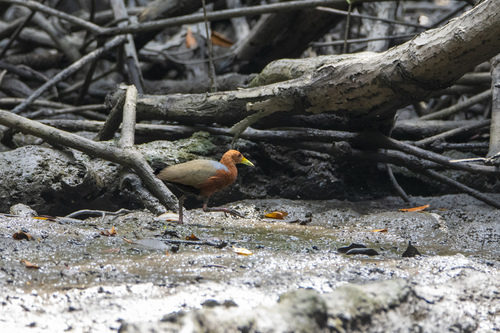
The rufous-necked wood rail is 29 to 33 cm (11 to 13 in) long and weighs about 300 to 325 g (11 to 11 oz). The sexes are alike. They have long, stout, yellow-green bills and red legs and feet. Adults' head, neck, and breast are rufous brown. Their nape and upper back are gray and the rest of the back olive brown to greenish olive. Their wings are greenish olive and chestnut. Their rump, tail, flanks, and undertail coverts are black. Their throat is white and their belly grayish brown. Juveniles are much duller overall. Their upperparts are like the adults' but duller. Voice: The rufous-necked wood rail's song has been described as "loud, irregularly paced kip and kow notes, e.g., kip-kow-kip, kow-kip-kow, kip-kowkip-kow, kow, kow, kow-kip". Pairs sing in duet "a strident series of musical notes...CHI burr... CHI burr... CHI burr....". They mostly sing at dusk and dawn but also at night. The species also makes "a cluck and kik in alarm".
Text from Wikipedia, licensed CC BY-SA 4.0.
When to see the Rufous-necked Wood Rail
One bar for each month. Filled bars are the 9 months with records; pale bars are months with none. The wide bar is January, the month with the most records.
Where to see the Rufous-necked Wood Rail
The map shades 13 countries with regular records, and 2 more in a lighter tone where the bird turns up only as a stray. Everything unshaded has no records. Countries are listed below the map.
Recorded as a rare visitor in United States, Panama.
About the Rufous-necked Wood Rail
The rufous-necked wood rail is a species of bird in the subfamily Rallinae of the rail, crake, and coot family Rallidae. It is found in Mexico, Central America, seven mainland South American countries, and Trinidad.
Text adapted from Wikipedia, licensed CC BY-SA 4.0.
Easily confused with
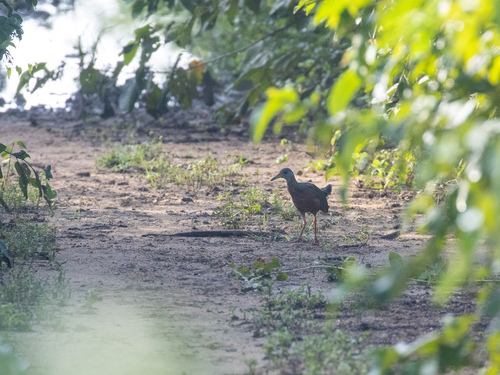 Little Wood RailAramides mangleThe little wood rail is 27 to 29 cm (11 to 11 in) long; one female weighed 164 g (5.8 oz).
 Brown Wood RailAramides wolfiThe brown wood rail is 33 to 36 cm (13 to 14 in) long.
Red-winged Wood RailAramides calopterusThe red-winged wood rail is 31 to 35 cm (12 to 14 in) long.
Brown Wood RailAramides wolfiThe brown wood rail is 33 to 36 cm (13 to 14 in) long.
Red-winged Wood RailAramides calopterusThe red-winged wood rail is 31 to 35 cm (12 to 14 in) long.
Side by side: Giant Wood Rail vs Rufous-necked Wood Rail · Rufous-necked Wood Rail vs Slaty-breasted Wood Rail · Rufous-necked Wood Rail vs Russet-naped Wood Rail
Learn the Rufous-necked Wood Rail in the BeakBrain App
Photo and call practice. Coming soon to iPhone and Android.
Play today's Daily BirdEvery photo and recording on this page is credited to its author under the licence shown. Spotted a problem with this page, or have a better photo? Contribute.